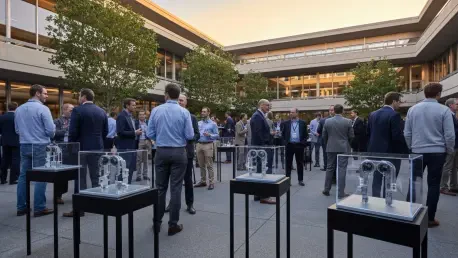

Imagine a world where whispered thoughts can be captured as text, or where the blind can see through retinal implants—innovations that sound like science fiction are becoming reality right now. At the StrictlyVC Palo Alto event hosted by Playground Global under the TechCrunch banner, the brightest minds in deep tech converged for an intimate gathering to discuss such groundbreaking ideas. This final installment of the year stood out as a melting pot of visionary thinkers, scientists, and investors, all focused on technologies that could redefine industries and human capabilities. Far from the buzz of mainstream tech, this event delved into the gritty, often unseen work of deep tech, from semiconductors to brain-computer interfaces. It’s a space where ideas are born long before they hit the public eye, making it a critical pulse-check for what’s on the horizon in a rapidly shifting landscape.
Exploring Cutting-Edge Innovations
Revolutionizing Semiconductor Manufacturing
At the heart of the discussions was the urgent need to address bottlenecks in critical tech sectors, with semiconductor manufacturing taking center stage. Nicholas Kelez, a particle accelerator physicist with decades of experience at the Department of Energy, shared his ambitious project to transform how chips are made. The industry currently relies on exorbitantly priced laser-based machines, costing upwards of $400 million each and produced solely by a Dutch firm, despite the technology’s American roots. Kelez is harnessing particle accelerator advancements to create a next-generation solution on U.S. soil. This endeavor isn’t just about innovation; it’s a strategic push for technological sovereignty in a world where global competition is intensifying. His work underscores a growing realization that reclaiming leadership in foundational technologies is no longer optional but a geopolitical necessity, especially as supply chains face unprecedented strain.
Moreover, Kelez’s project reflects a broader shift toward tackling complex, systemic challenges in tech infrastructure. Beyond the technical wizardry, his approach signals a call to action for nations to invest in homegrown solutions that can withstand global disruptions. While the intricacies of particle accelerators might seem esoteric to the average observer, the implications are anything but—think faster, cheaper, and more secure chip production that powers everything from smartphones to defense systems. The conversation at Palo Alto painted a vivid picture of an industry at a crossroads, where innovation must align with strategic priorities. Kelez’s vision isn’t just a fix for a manufacturing snag; it’s a blueprint for how deep tech can address issues that ripple across economies and security frameworks worldwide.
Advancing Human-Computer Interaction
Another captivating frontier explored at the event was the evolution of human-computer interaction, particularly through wearable and neural technologies. Mina Fahmi, co-founder of Sandbar, introduced the Stream Ring, a device that captures whispered thoughts and converts them into text—a tool designed not just as a novelty but as an extension of human cognition. Supported by Toni Schneider of True Ventures, whose track record includes backing hardware successes like Peloton, this technology hints at a future where mental and digital boundaries blur. The implications are staggering, from enhancing communication for those with speech impairments to revolutionizing how ideas are recorded and shared. Fahmi’s work challenges the notion of technology as a mere accessory, positioning it instead as a seamless part of human expression.
In a similar vein, Max Hodak of Science Corp., a former co-founder of Neuralink, discussed his pioneering efforts in neurotechnology. His focus on retinal implants to restore vision for the blind and “biohybrid” brain-computer interfaces—merging chips with stem cells that grow into brain tissue—offers hope for life-changing medical breakthroughs. These interfaces could enable paralyzed individuals to control devices through thought alone. Hodak envisions a radically transformed world within the next decade, driven by such advancements. His perspective adds depth to the event’s narrative, showing how deep tech isn’t just about gadgets but about redefining human potential. Together, Fahmi and Hodak’s contributions highlight a shared belief: technology can and should augment lives in profound, meaningful ways, solving challenges once deemed impossible.
Redefining Investment Strategies
Shifting Focus Beyond Enterprise AI
Venture capitalists at the event brought a sharp, contrarian lens to the deep tech conversation, urging a rethink of where resources are funneled. Chi-Hua Chien of Goodwater Capital and Elizabeth Weil of Scribble Ventures, known for early bets on transformative companies like Twitter and SpaceX, argued that Silicon Valley’s obsession with enterprise AI is crowding out other vital opportunities. Their contention is that while AI dominates headlines and funding, equally critical areas like hardware innovation and neurotechnology risk being sidelined. This misallocation could stifle the very breakthroughs needed for long-term progress. Their insights resonate as a wake-up call, pushing for a more balanced approach that doesn’t chase trends at the expense of diverse, game-changing ideas.
Adding to this, their perspective emphasized the importance of spotting potential before it becomes obvious to the masses. By drawing on past successes, Chien and Weil underscored how today’s overlooked innovations could be tomorrow’s household names if given the right support. The Palo Alto discussions revealed a tension in the investment world—between playing it safe with proven sectors like AI and taking bold risks on uncharted territories. This isn’t just about money; it’s about shaping the future of tech by diversifying focus. Their candid critique at the event served as a reminder that deep tech’s promise lies in its breadth, not in narrow fixation. The challenge now is for investors to act on this wisdom, ensuring that capital flows to the full spectrum of innovation.
Fostering Collaboration and Insight
The role of events like StrictlyVC in driving deep tech forward was also a key talking point, amplified by the presence of industry heavyweights like Pat Gelsinger, former Intel CEO, and host Playground Global. Such gatherings provide a rare platform for candid dialogue among scientists, entrepreneurs, and investors, often sparking collaborations that shape industry trajectories. Past events in cities like Washington, D.C. and San Francisco have proven their prescience, with discussions foreshadowing major shifts—think high-profile predictions about artificial general intelligence that seemed far-fetched at the time but later materialized. Palo Alto continued this legacy, creating a space where niche ideas gain traction through shared expertise and vision.
Furthermore, the intimate setting of the event fostered a unique synergy, distinct from larger, more impersonal conferences. It allowed for deeper connections, where a physicist like Kelez could exchange ideas with a VC like Chien, potentially birthing partnerships that bridge technical and financial worlds. This cross-pollination is vital for deep tech, a field often siloed by its complexity. The event’s global reach, reflected in its history of impactful conversations across continents, reinforces its role as an incubator for what’s next. Looking back, it’s clear that Palo Alto stood as a testament to the power of bringing diverse voices together, ensuring that the future of technology isn’t just imagined but actively built through collaboration.