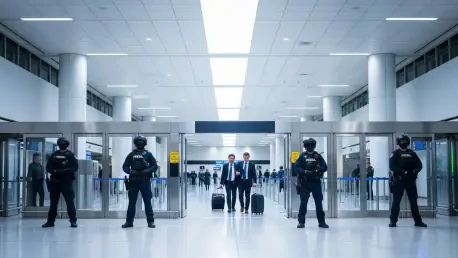

Travelers navigating the sprawling terminals of America’s busiest aviation hubs are currently witnessing an extraordinary sight as armed federal agents take up positions alongside weary airport security personnel. Starting Monday, March 23, 2026, the familiar landscape of domestic travel shifted fundamentally as Immigration and Customs Enforcement personnel began supplementing the Transportation Security Administration at 14 major transit centers. This development represents a desperate measure to salvage a crumbling infrastructure crippled by a prolonged partial government shutdown.
The intersection of border enforcement and civilian travel logistics has created a tense atmosphere for millions of passengers. As staffing levels plummeted to historic lows, the federal government chose to pivot specialized enforcement assets into the heart of the American transportation network. This move signals a significant departure from traditional administrative norms, turning airports into the latest front of a broader fiscal and political battle.
The Unprecedented Convergence: Federal Enforcement and Aviation Logistics
The sight of armed agents flanking security checkpoints marks a startling shift in domestic travel protocols. This is not a routine exercise; it is a direct response to a state of paralysis within the agency responsible for keeping the skies safe. The integration of enforcement personnel into civilian spaces highlights the fragile nature of modern logistics when federal funding ceases to flow.
Specialized units are now performing roles far removed from their primary mission. While these agents bring a high level of security expertise, their presence changes the psychological experience of the average traveler. The transition from a civilian-led screening process toward a more militarized enforcement environment has happened almost overnight, leaving many to wonder about the long-term implications of such a convergence.
The Breaking Point: How a Fiscal Standoff Paralyzed American Skies
The current instability traces back to a legislative deadlock that forced security officers to maintain essential operations without receiving a paycheck. Predictably, this financial strain triggered a massive wave of resignations and coordinated “sick-outs” that left checkpoints dangerously understaffed. Lines that once moved in minutes began to stretch for hours, threatening to halt the flow of commerce and travel entirely.
When security bottlenecks began to cascade across the continent, the necessity for a contingency plan became undeniable. The deployment of ICE agents illustrates a growing trend where specialized agencies are diverted to fill structural gaps caused by fiscal instability. This temporary patch serves as a stark reminder of how political volatility can directly disrupt the daily lives of citizens and the safety of the national airspace.
Mapping the Deployment: Strategic Hubs and Operational Objectives
Under the direction of Border Czar Tom Homan, the administration prioritized high-traffic gateways where the risk of a total network collapse was most acute. Key deployments were concentrated at New York’s JFK and LaGuardia, Newark, Philadelphia, Chicago O’Hare, Atlanta Hartsfield-Jackson, New Orleans, Houston, and Phoenix Sky Harbor. These hubs represent the arteries of American aviation, making their functionality a matter of national security.
These agents are primarily assuming peripheral duties to streamline the screening process. By taking over perimeter monitoring and line management, these personnel allow the remaining screening staff to focus exclusively on technical passenger inspections. However, the operation remains complex due to its dual mandate, blending logistical support with an aggressive immigration enforcement presence within federal facilities.
Enforcement vs. Efficiency: Perspectives from the Front Lines
Homeland Security officials admitted that while the priority was to restore movement, the integration of enforcement agents into airports marked a significant policy escalation. While some leaders focused on the logistical necessity of keeping lines moving, the administration also framed the action as a tool for the immediate arrest of undocumented individuals encountered during security checks. This shift turned the screening process into a multi-layered checkpoint for both safety and status.
This conflicting messaging created a complex environment for both travelers and airport staff. Policy experts argued that using a staffing crisis to expand the footprint of immigration enforcement could have lasting impacts on public trust. The debate centered on whether the urgency of maintaining flight schedules justified the presence of agents whose primary training involves enforcement rather than the nuances of civilian aviation protocol.
Navigating the New Security Landscape: A Guide for Travelers
Travelers adjusted their expectations as the integration of federal enforcement into airport operations became the temporary reality. Many passengers increased their arrival windows by at least two hours to account for more rigorous scrutiny and the hybrid staffing models now in place. Understanding that these agents possessed broader authority than standard screeners became a necessary part of trip preparation and domestic navigation.
The situation required the public to remain vigilant regarding the status of federal budget negotiations, as fiscal outcomes dictated the duration of the deployment. Authorities recommended that individuals carry updated documentation and stay informed through official government portals. Proactive measures by travelers helped mitigate some of the chaos as the nation sought a return to civilian-led aviation security.