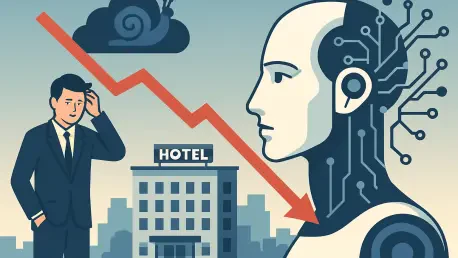

The US hotel industry stands at a significant crossroads, moving beyond the frenetic pace of post-pandemic recovery into a more measured but complex period of sustained recalibration. This new environment presents a dual challenge for operators, who must now navigate the complexities of inconsistent consumer demand and persistent economic pressures while simultaneously confronting the transformative disruption of artificial intelligence. The era of rapid, universal growth has given way to a more nuanced market that demands greater strategic precision and operational agility.
This period of adjustment is defined by a landscape where gains are harder to achieve and market segments are performing with increasing divergence. Hoteliers are tasked with protecting profit margins against a backdrop of inflationary pressures and rising operational costs. Moreover, the accelerating integration of AI into travel planning and booking processes is fundamentally altering how consumers discover and choose accommodations, creating both unprecedented opportunities for engagement and significant threats to traditional business models.
A New Era of Recalibration for the US Lodging Industry
After an extended period of vigorous resurgence, the hospitality sector now faces a more normalized, yet distinctly less forgiving, market. The rebound that characterized the immediate post-pandemic years has matured into a phase of stabilization, bringing with it a new set of economic realities. This forecast is critical for industry stakeholders as it provides a data-driven framework for understanding the forces that will shape performance and profitability in the current climate.
The insights are particularly relevant for those making long-term strategic decisions. With economic uncertainty persisting and fundamental shifts occurring in technology and consumer behavior, a clear-eyed view of the path ahead is essential. This research offers a guide for navigating the intersecting challenges of modest growth, market fragmentation, and technological evolution, helping leaders allocate resources effectively and anticipate future trends.
Navigating the Post-Pandemic Hospitality Landscape
Methodology
The research approach is built upon a comprehensive analysis of interconnected data streams to generate a robust and reliable forecast. The methodology integrates a deep dive into key macroeconomic indicators, including inflation rates and capital costs, which directly influence both consumer spending power and development activity. These broad economic factors provide the foundational context for understanding the market’s potential.
In parallel, the analysis scrutinizes lodging industry-specific performance metrics, with a focus on Revenue Per Available Room (RevPAR), average daily rates, and occupancy levels. This granular data is examined alongside emerging market trends, such as shifts in travel patterns and the adoption of new technologies. By synthesizing these diverse elements, the methodology produces a holistic projection that accounts for the complex interplay between the economy, industry performance, and forward-looking market dynamics.
Findings
The core projection indicates a modest 0.9 percent increase in RevPAR for the current year, with the national average occupancy rate expected to remain stable at 62 percent. The forecast anticipates a challenging start, with RevPAR headwinds in the first two quarters, followed by a moderate acceleration in the latter half of the year. This anticipated improvement is contingent on a more stable macroeconomic climate, more favorable year-over-year comparisons, and the positive demand generated by major national events.
A primary discovery is the significant bifurcation of demand, creating a two-track recovery. On one hand, leisure travel remains robust, particularly in warmer climates and secondary markets driven by events and wellness tourism. On the other hand, the rebound in corporate, group, and inbound international travel continues to be slower and more unpredictable. This divergence extends to performance, with higher-priced hotels poised to outperform their lower-priced counterparts. This disparity is fueled by resilient spending among higher-income households, strong group and meeting demand, and slower supply growth in the luxury and upper-upscale segments.
Conversely, the industry faces considerable challenges that will temper overall growth. Persistent inflationary pressures are expected to create a drag on profit margins, while supply growth is set to outpace demand, intensifying competition. Furthermore, elevated capital costs and high interest rates continue to weigh on consumer spending and new development. Looming over these economic factors is the accelerating influence of artificial intelligence, which is rapidly emerging as a transformative force reshaping hotel operations, marketing, and the fundamental ways properties connect with travelers.
Implications
These findings carry significant practical consequences for hotel operators, demanding a pivot in strategy and operations. The fragmented demand landscape necessitates a shift toward highly targeted marketing campaigns designed to capture specific traveler segments, from event-driven leisure guests to corporate groups. Simultaneously, to protect margins in a slow-growth environment, an intensified focus on operational efficiency is paramount. This includes leveraging technology to streamline processes, manage labor costs, and optimize resource allocation.
Perhaps the most profound implication lies in adapting to the rise of AI-driven “agentic commerce.” As intelligent assistants and large language models increasingly influence travel decisions at the earliest stages of planning, hotels must develop new engagement models to remain competitive. This technology can surface personalized options and narrow the booking funnel long before a potential guest visits a hotel’s website. Consequently, success will depend on a brand’s ability to be visible and compelling within these new AI-powered ecosystems, redefining the very nature of customer acquisition and loyalty.
Reflection and Future Directions
Reflection
Forecasting in today’s volatile economic climate is an inherently complex endeavor. The primary challenge lies in balancing powerful macroeconomic headwinds, such as stubborn inflation and high interest rates, with sector-specific trends like the uneven recovery in business travel. These forces often pull in opposite directions, making it difficult to project a single, linear path for the industry.
An additional layer of complexity comes from the rapid evolution of technology, particularly artificial intelligence. While the disruptive potential of AI is clear, the precise speed and scale of its impact on hotel operations and consumer booking patterns remain difficult to predict. This uncertainty requires forecasters and industry leaders alike to plan for multiple scenarios and maintain a flexible approach to strategy, acknowledging that the technological landscape could shift dramatically in a short period.
Future Directions
Looking ahead, several key areas warrant further research and close monitoring. A central question is how hotels can effectively integrate AI not just for booking but to personalize the entire guest experience, from pre-arrival communication to on-property services. Understanding how to leverage this technology to build deeper, more meaningful customer relationships will be critical for differentiation.
Additionally, the industry must continue to track the long-term evolution of the balance between leisure and business travel, as this dynamic will shape everything from hotel design to marketing investment. Finally, new business models may need to emerge to address the sustained pressure on lower-priced market segments. Investigating innovative operational or financing structures could reveal pathways to profitability and resilience for properties facing the strongest economic headwinds.
Conclusion Adapting to a Future of Modest Growth and Technological Disruption
The analysis confirmed that the US hotel industry had moved beyond its rapid recovery phase and entered a period of recalibration. This new era was characterized by a distinct slowdown in growth, significant performance divisions between market segments, and the pervasive influence of disruptive technologies. The market’s dynamics had shifted from broad-based expansion to a more challenging environment where success demanded strategic precision.
Ultimately, the ability to thrive in this landscape depended on a commitment to proactive adaptation and operational agility. The research underscored that sustained profitability would be achieved not by waiting for a return to previous conditions but by embracing innovation. In particular, the strategic integration of artificial intelligence emerged as a critical determinant of future success, offering the tools necessary to navigate a future defined by modest growth and profound technological change.