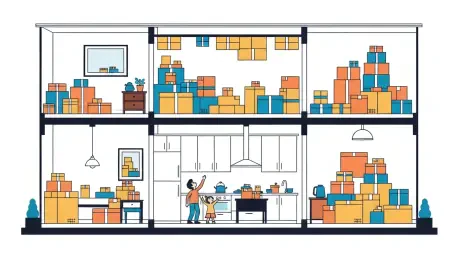

A bizarre and persistent logistical error within Amazon’s delivery system has turned a Washington, D.C. family’s home into an unwilling and overwhelmed fulfillment center, inundating them with over 100 packages intended for a nearby historic hotel over the last six months. This extraordinary situation, rooted in a simple one-letter difference between the family’s home address and that of the Arlo Hotel, has spiraled from a minor inconvenience into a significant source of distress, raising serious questions about the safeguards and error-correction protocols within the world’s largest e-commerce platform. For the homeowner, Brittany, and her family, what began as a curious mix-up has evolved into a daily struggle, highlighting the profound real-world consequences that can arise from a single, overlooked digital discrepancy. The ordeal serves as a stark reminder of the delicate balance between automated efficiency and the potential for systemic failure when human oversight is absent, leaving ordinary citizens to grapple with the fallout of corporate-level mistakes.
A Deluge of Misdirected Deliveries
The root of the family’s predicament was traced to a subtle yet critical flaw in Amazon’s addressing database, where their residential address was nearly identical to that of the prominent Arlo Hotel, a popular destination for travelers in the city. This single-letter discrepancy proved sufficient to reroute a torrent of guest orders directly to their doorstep. Over a period of six months, the family found themselves managing a relentless stream of packages, transforming their home into an impromptu warehouse. Initially, the deliveries consisted of relatively mundane items, such as cat food and vitamins, creating a manageable, albeit frustrating, logistical puzzle. The family attempted to handle the situation by storing the items and coordinating with the hotel, but the sheer volume quickly became overwhelming. This consistent error underscored a vulnerability in the automated sorting and delivery process, where the system repeatedly failed to distinguish between a private residence and a large commercial establishment, demonstrating a lack of adaptive learning or flagging mechanisms for recurrent delivery failures to the same incorrect address.
As the weeks turned into months, the nature of the misdelivered items and the consequences of the error escalated dramatically, shifting the family’s experience from one of inconvenience to genuine alarm and personal invasion. The turning point occurred with the unexpected arrival of a chainsaw, an item so out of place and potentially dangerous that it marked what the homeowner described as the “breaking point.” This single delivery crystallized the absurdity and the underlying security risk of the situation. The problem intensified further when guests from the Arlo Hotel, tracking their packages to the family’s address, began arriving at the private residence to claim their property. These encounters, sometimes happening after 8 p.m., created an unsettling and unsafe atmosphere for a family with young children. The constant stream of strangers arriving at their door eroded their sense of privacy and security, illustrating how a seemingly impersonal technical glitch could manifest as a direct and repeated intrusion into their personal lives, leaving them feeling exposed and helpless.
Navigating Corporate Responses and Public Scrutiny
In response to the escalating crisis, the family sought assistance from the corporations at the center of the mix-up, receiving distinctly different reactions that highlighted varying approaches to customer service and accountability. Amazon, whose system was the source of the error, acknowledged the issue and provided assurances that it was actively investigating the matter. This response, while not an immediate solution, suggested a recognition of the problem’s severity. Industry observers speculate that such a high-profile failure could compel the e-commerce giant to implement more sophisticated address verification systems. Potential upgrades could include algorithms that cross-reference address types, flagging discrepancies when commercial-scale orders are routed to a residential zone, or a system that triggers a manual review after a certain number of failed or misdirected delivery reports to the same address. In stark contrast, the Arlo Hotel, a historic and prominent landmark in the city, chose to remain silent on the matter, issuing no public comment. This lack of engagement left the family to manage not only the physical packages but also the hotel’s guests who arrived at their home seeking their belongings.
The Aftermath and Future Implications
Ultimately, the public exposure of this prolonged ordeal was what prompted a definitive resolution for the family, transforming their private struggle into a widely discussed case study on the fallibility of modern logistics. The incident moved beyond a local news curiosity and became a touchstone for conversations about the unforeseen consequences of hyper-automated e-commerce. It served as a potent example of how a seemingly minor data error could spiral into a significant disruption of personal life, privacy, and security. The story highlighted a critical gap in corporate responsibility, where the systems designed for convenience failed to account for their real-world impact on individuals caught in the crossfire. The resolution underscored the power of public awareness in holding large corporations accountable and spurred a necessary dialogue on creating more resilient, human-centric systems. This event left a lasting mark, illustrating that as technology becomes more integrated into daily life, the need for robust, intelligent, and responsive error-correction mechanisms has never been more critical to protect consumers from the fallout of digital mistakes.