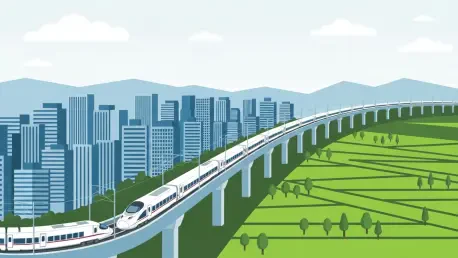

Today, we’re joined by Katarina Railko, a leading expert in hospitality and tourism whose work closely examines the transformative power of transportation infrastructure. With China investing billions into creating the world’s most advanced high-speed rail network, we’ll explore how this monumental undertaking is reshaping not only domestic travel but also regional economies and the very fabric of the passenger experience. Our conversation will delve into the strategies behind the staggering passenger volumes on cross-border lines, the tangible impact of massive infrastructure investments on the traveler’s journey, and the meticulous process of launching new routes. We will also touch upon the cutting-edge technology and sustainability initiatives that place China at the forefront of global rail innovation and look ahead to what the future holds for this rapidly evolving network.
The Guangzhou–Shenzhen–Hong Kong line carried nearly 29 million passengers, while the China-Laos railway saw 244,000. Could you detail the specific operational strategies that drove this high volume and explain how these cross-border services are fostering economic integration in both the Greater Bay Area and Southeast Asia?
The incredible figure of nearly 29 million passengers on the Guangzhou–Shenzhen–Hong Kong line isn’t just a number; it’s a testament to a strategy of deep, seamless integration. Operationally, this is achieved through high-frequency service that essentially turns the railway into a super-commuter line for the entire Greater Bay Area. It’s about making the journey between Hong Kong and mainland cities so fast and frictionless that it becomes an everyday option for business, leisure, and family visits. This constant flow of people directly fuels economic integration by erasing logistical barriers, encouraging cross-border investment, and creating a unified regional market. The China-Laos railway, while smaller in passenger volume, plays a different but equally crucial strategic role. It serves as a foundational artery, a proof of concept for China’s broader vision in Southeast Asia, strengthening economic ties and laying the groundwork for a much larger, interconnected regional network.
With a 5.9% investment increase to over $106 billion in 2025, what specific modernization projects are being prioritized? Could you walk us through how this funding directly translates into the “state-of-the-art stations” and “advanced ticketing systems” that are enhancing the passenger journey?
That $106.5 billion investment is being channeled directly into tangible upgrades that redefine the travel experience from the ground up. When we talk about “state-of-the-art stations,” we’re moving beyond mere transit hubs. This funding builds vast, architecturally stunning spaces that integrate retail, dining, and seamless connections to local subways and buses, making them destinations in their own right. For the passenger, this means less stress and more convenience. The funding for “advanced ticketing systems” is all about eliminating friction. It’s about moving away from paper tickets and long queues to a fully digital, often facial-recognition-enabled, process where your phone or even just your face is your ticket. This transforms the journey into a smooth, uninterrupted flow from the station entrance to your seat, which is a core expectation for the modern traveler.
The Panzhou–Xingyi high-speed railway launched on November 28, with other lines like Guangzhou–Zhanjiang in trial runs. Can you describe the final technical and safety checks involved in these trials and share some projected metrics on how these new routes will impact regional economic growth and connectivity?
The trial runs for new lines like Guangzhou–Zhanjiang are the critical final act before the public launch. They are incredibly thorough, involving weeks of running empty and then partially loaded trains at varying speeds, including well above the planned operational speed. Engineers meticulously test every component, from the integrity of the tracks and the reliability of the power systems to the precision of the signaling and communication networks. Safety drills are run repeatedly to ensure every protocol is flawless. The launch of the Panzhou–Xingyi line, following these checks, is a game-changer. These new routes slash travel times that once took many hours by road down to just a couple of hours by rail. This dramatic increase in accessibility is a powerful catalyst for regional economies, opening up smaller cities to tourism, making them more attractive for business investment, and connecting their residents to larger markets and opportunities.
China is positioned as a global leader with trains exceeding 350 km/h and a focus on sustainability. Beyond speed, what specific cutting-edge technologies are being deployed to enhance safety and efficiency? And how do you quantify the environmental benefits of shifting millions of travelers to this rail network?
While the 350 km/h speeds are what grab the headlines, the real innovation lies in the almost invisible technologies that make the system work so safely and efficiently. We’re seeing extensive use of onboard sensors and trackside monitoring systems that provide real-time data on the health of the entire network, allowing for predictive maintenance that fixes problems before they can cause delays or safety issues. Advanced centralized traffic control systems use sophisticated algorithms to manage train movements with pinpoint precision, maximizing the number of trains that can run on a line without compromising safety. The environmental benefits are immense and quantifiable. Every time a traveler chooses a high-speed train over a short-haul flight or a long car journey, there is a significant and direct reduction in carbon emissions per passenger. When you multiply that by the tens of millions of passengers making that choice, you’re looking at one of the most impactful green transportation initiatives in the world, a core part of China’s strategy to build a more sustainable future.
What is your forecast for the next decade of China’s high-speed rail development, particularly regarding international expansion and the integration of emerging technologies like AI and IoT into the passenger experience?
Looking ahead, I believe the next decade will be defined by two key trends: deeper international connectivity and a hyper-personalized passenger experience. We will see the network push further beyond China’s borders, building on successes like the China-Laos line to create a more integrated Pan-Asian rail system that could one day connect to Europe. Domestically, the integration of AI and the Internet of Things will become standard. Imagine a journey where an AI-powered app not only books your ticket but also arranges your taxi, checks you into your hotel, and provides real-time updates and personalized recommendations based on your travel patterns. IoT sensors in your luggage could allow you to track it seamlessly throughout your journey. The focus will shift from just moving people quickly between two points to creating an intelligent, interconnected, and completely frictionless end-to-end travel ecosystem.