
With a deep understanding of the travel and tourism industry, Katarina Railko has become a key voice in hospitality development, particularly in the boutique hotel space. Her expertise lies in identifying how design, sustainability, and guest experience converge to create properties that are not just places to stay, but destinations in themselves. Today, she shares her insights on the meticulous transformation of a classic 1965 motor lodge into the Commodore Motel, a project that redefines the modern roadside retreat.
Your goal was to capture Mystic’s authentic spirit. Beyond the location, how did you translate this maritime charm into tangible design elements like the stateroom-style ceilings and specific color palette? Could you walk us through the collaborative process that brought this vision to life?
Our guiding principle was to create something that felt distinctly Mystic, not a generic hotel that could exist anywhere. We wanted to bottle that authentic, maritime spirit. The collaborative process with Cate Mills of Ellison Mills Studio and architect Mark Comeau was essential. We started by deconstructing what “maritime” means today—it’s not about being literal with anchors and rope. Instead, we translated it into feelings and forms. The curved, stateroom-style ceilings are a perfect example; they subtly evoke the inside of a ship’s cabin without being a caricature. We then layered in a very intentional color palette—cobalt, bright red, and powder blue—which feels both retro and coastal, completing that aesthetic we were aiming for.
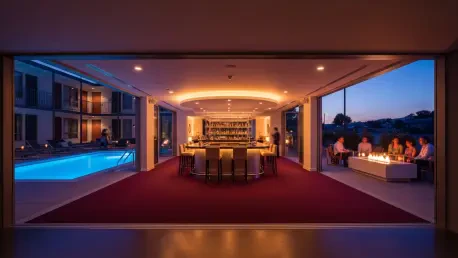
The lobby, with its burgundy floors and central bar, opens directly onto the pool terrace. What was the thinking behind creating this connected social hub, and how do you envision guests using the indoor-outdoor space, from the fire tables to the poolside bar?
The lobby was designed to be the heart of the property, a true anchor for the guest experience. We consciously avoided a traditional, transactional check-in counter. Instead, the central bar immediately signals that this is a place to linger and connect. The decision to have the entire space open up to the pool terrace through large glass doors was about erasing the boundary between inside and out. We envision guests starting their evening with a drink at the bar, then seamlessly moving outside to gather around the fire tables or lounge by the seasonal heated pool. It’s designed to be a dynamic, fluid social hub that encourages interaction and relaxation from day into night.
Guestrooms feature a unique blend of modernist design and materials like oak and cork. What was the inspiration behind the custom bed’s circular opening into the bathroom, and how does this unconventional feature contribute to the overall “utilitarian elegance” you aimed for?
The guestrooms are where we really pushed the concept of “utilitarian elegance.” The materials—solid oak, resilient cork flooring, and stainless steel—are honest and functional, lending a sense of durability and purpose. The custom oak bed frame is the centerpiece, and the circular opening was a key design move. It acts almost like a porthole, offering a playful glimpse into the bathroom while framing the pale green headboard. This feature merges early modernist influences with that ship-inspired feeling, creating visual intrigue and a sense of openness in a compact space. It’s an unconventional touch that prevents the room from feeling sterile and perfectly embodies that blend of practicality and refined design.
Restoring the original 1965 motor lodge was a key decision. Can you describe the specific challenges and trade-offs involved in renovating an existing structure versus building new, particularly when integrating modern sustainable systems like the rooftop solar array and VRF system?
Choosing to restore the original motor lodge was foundational to our mission. The biggest benefit was preserving a piece of Mystic’s character while making a significant environmental statement by reducing the project’s carbon footprint. However, working with a 1965 structure presents unique challenges. You have to be incredibly strategic when integrating state-of-the-art systems like the rooftop solar array and the high-efficiency VRF system, which provides all our heating and cooling with zero carbon emissions. It requires more surgical precision than a new build, where you have a blank slate. The trade-off is that you might sacrifice some layout flexibility, but what you gain in character, history, and sustainability is immeasurable.
You’ve implemented several environmentally-minded amenities, from EV chargers to reusable water bottles. What metrics will you use to track the impact of these sustainable features, and what has been the most complex part of making the property operationally “responsible and functional”?
Making the property both responsible and functional has been a core focus. We’ll track the impact through direct metrics, such as monitoring the energy produced by our rooftop solar array and measuring the reduction in single-use plastic waste by providing chilled filtered water taps and complimentary reusable bottles in all 59 rooms. We can also track the usage of our on-site EV charging stations. The most complex part isn’t just installing these features; it’s weaving them into the operational DNA of the motel so they are seamless for the guest. The goal is for sustainability to be an effortless, integrated part of the experience, not an inconvenient afterthought.
What is your forecast for the boutique motel industry, especially regarding the trend of renovating and reimagining historic roadside properties for modern travelers?
I believe we are at the beginning of a golden age for the boutique motel. Modern travelers are increasingly seeking out properties with a genuine story and a strong sense of place, and these renovated roadside lodges offer exactly that. They provide a nostalgic charm that you simply cannot replicate in a new build. My forecast is that this trend will accelerate, with a greater emphasis on hyper-local design, high-quality social spaces, and authentic sustainability. The properties that succeed will be those that, like the Commodore, honor their history while thoughtfully reimagining the experience for a new generation of travelers who value character and conscious consumption.