
With an expert eye for destinations that offer more than just a place to stay, Hospitality expert Katarina Railko has built a career discovering the soul of travel. Her work in the tourism industry, particularly with expos and conferences, has given her a unique perspective on what travelers truly seek: authentic experiences away from the crowds. Today, she joins us to discuss the rising desire for tranquility, exploring how certain coastal destinations in the US are preserving their charm. We’ll touch on what makes these places special, from car-free islands to the delicate balance between adventure and serenity, and delve into how travelers can choose the right kind of quiet retreat for their needs.
Edisto Beach, South Carolina, is described as an unspoiled retreat with 37 public access points. How does this combination of accessibility and preservation shape the visitor experience, and what specific activities would you recommend for someone seeking to fully appreciate its natural, undeveloped charm?
That’s the beautiful paradox of Edisto, isn’t it? The 37 access points mean you’re never struggling to find a path to the shore, yet once you’re there, it feels like your own private discovery. This design prevents the bottlenecks you see at other beaches, where everyone funnels into one or two main entrances. Instead, people are naturally dispersed along the five-mile coastline. The experience is immediately more personal and serene. The “gentle development”—the cottages and homes instead of towering resorts—means the skyline is dominated by nature, not concrete. To truly connect with its charm, I’d recommend a sunrise walk where the only footprints you see might be your own, or spending an afternoon simply tide-pooling without the constant chatter of a crowded beach. It’s a place that encourages you to slow down and listen to the rhythm of the waves rather than the noise of a tourist hub.
Sebastian Inlet State Park in Florida attracts both surfers and birdwatchers. How do these distinct activities coexist in one location, and what advice can you offer a first-time visitor looking to experience both the park’s thrilling surf breaks and its serene wildlife trails?
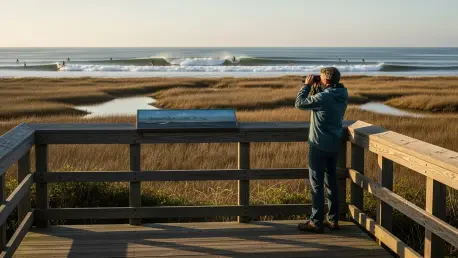
Sebastian Inlet is a masterclass in how a single location can cater to completely different energies. The surfers are drawn to the dynamic energy of the waves, the thrill of the break, while the birdwatchers are seeking the exact opposite: stillness and quiet observation. The park’s layout is key; the high-action surf spots are concentrated, leaving vast, tranquil areas for the Great Florida Birding and Wildlife Trail to meander through. They don’t overlap in a disruptive way. For a first-timer, I’d suggest dedicating a full day and splitting it. Start your morning with the surfers; even if you don’t ride the waves, the energy is incredible to watch. Then, as the afternoon sun softens, transition to the wildlife trails. Pack a pair of binoculars, find a quiet spot, and just wait. The patience required for birdwatching is a perfect counterbalance to the adrenaline of the surf, allowing you to experience the full, diverse personality of the park.
Bald Head Island, North Carolina, is a car-free environment where most of the land is a protected nature reserve. How does this unique, transportation-limited setting impact a vacation from the moment one steps off the ferry, and what are some practical tips for navigating the island effectively?
The moment you step off that ferry from Southport, your entire mindset shifts. The absence of engine noise is the first thing you notice; it’s replaced by the sounds of nature and the quiet hum of golf carts. Your vacation pace is immediately and forcibly slowed down, which is the entire point. Out of the island’s 12,000 acres, a staggering 10,000 are protected reserves, so you are truly immersed in an untouched landscape. My practical tip is to embrace this from the start. Rent your golf cart or bicycle as soon as you arrive, as they are your lifelines. Don’t overschedule your days. Instead, use your chosen transport to meander; get intentionally lost on the sandy paths, explore the maritime forest, and pack a picnic for a secluded beach you discover. It’s less about getting from point A to B efficiently and more about enjoying the journey itself.
Locations like Shell Island and Sandbridge Beach offer peaceful alternatives to nearby bustling tourist spots. What are the key differences between the seclusion of an undeveloped barrier island versus a quiet coastal community, and how can a traveler decide which type of retreat is right for them?
This is a great question because “quiet” can mean very different things. Shell Island is raw, untouched seclusion. It’s a short ferry ride from the energy of Panama City Beach, but it feels a world away because it’s an undeveloped barrier island. You have to bring everything you need—water, food, shade—and take it all back with you. It’s for the traveler who wants to truly disconnect and be immersed in pure nature: snorkeling, shelling, dolphin watching. Sandbridge Beach, on the other hand, offers seclusion with amenities. It’s a quiet coastal community 25 miles from the buzz of Virginia Beach, but you can still rent a comfortable house, go to a local market, and have a home base. It’s a retreat for someone who wants to escape the crowds but still values the comfort and convenience of a community. The choice comes down to your desired level of immersion: do you want to be a visitor in nature’s home, or a resident in a peaceful town?
As more travelers seek out quiet coastal getaways, what are the tell-tale signs that a “hidden” beach is successfully balancing discovery with preservation, and what steps can visitors take to help maintain the tranquility and natural beauty of these special places?
A key sign is managed access. Places like Edisto with its numerous public points, or islands accessible only by ferry, show intentional design to prevent overcrowding in any single area. You’ll also see a strong emphasis on what’s not there: a lack of sprawling commercial development, limited parking, and clear signage about protecting wildlife, like at Back Bay National Wildlife Refuge near Sandbridge. The most important thing visitors can do is adopt a “leave no trace” mentality, which goes beyond just packing out trash. It means sticking to designated trails to protect dunes, keeping a respectful distance from wildlife, and supporting local businesses that champion conservation. It’s about becoming a temporary steward of the place, ensuring that the tranquility you came to find is still there for the next person.
What is your forecast for the future of “hidden gem” beach travel as more people seek to escape mass tourism?
I believe the demand for these “hidden gems” will only intensify. The core desire isn’t just about avoiding crowds; it’s about seeking authentic, meaningful connections with nature and place, which is something mass tourism often strips away. The challenge and the opportunity lie in management. The most successful destinations will be those that proactively protect their essence—like Bald Head Island has with its development limits and car-free policy. We’ll likely see more reservation systems for sensitive areas, a greater emphasis on eco-tourism, and travelers becoming more educated and intentional about their impact. The future isn’t about keeping these places secret, which is impossible in our connected world, but about cultivating a culture of respect and stewardship so they remain special. The “hidden gem” of tomorrow will be defined less by its obscurity and more by its preserved character and commitment to sustainability.