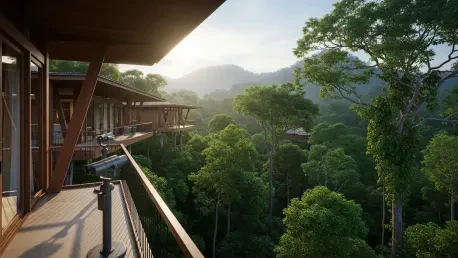

The dense, emerald canopies of the Bornean jungle are no longer just a backdrop for adventure; they have become the front line of a sophisticated movement to merge high-end travel with rigorous environmental stewardship. While many destinations struggle to balance visitor numbers with environmental health, Sabah has quietly secured over 30 percent of its landmass—totaling 2.227 million hectares—under strict protection. This milestone doesn’t just meet international conservation benchmarks; it shatters them. The state is pivoting away from high-volume foot traffic toward a model of high-value, low-impact tourism that prioritizes the integrity of the ecosystem over short-term profit. By transforming its “Lost World” into a living laboratory, Sabah is proving that the future of travel lies in the preservation, rather than the consumption, of natural wonders.
Why the Borneo Blueprint Matters for Global Biodiversity
In an era of rapid climate change and habitat loss, Sabah’s commitment to the Forest Stewardship Council (FSC) standards provides a rare example of institutionalized sustainability. This matters because the state’s governance and transparency are now directly linked to its ability to attract international climate and biodiversity funding. By maintaining vast, contiguous tracts of forest, Sabah serves as a critical carbon sink and a sanctuary for endangered flora and fauna.
For the global travel industry, this sets a new standard where the success of a destination is measured by its ecological resilience and its ability to secure long-term environmental financing. This shift ensures that the natural capital remains intact for future generations while providing a stable foundation for the economy.
Transforming Protected Areas into Niche Tourism Powerhouses
Sabah is strategically evolving its protected regions into specialized hubs for research, education, and premium niche tourism. A cornerstone of this strategy is the establishment of the Avian Centre of Excellence at the Maliau Basin through a partnership with the Malaysian Nature Society. This initiative digitizes bird species data for global scientific use while tapping into the lucrative, low-impact birdwatching market.
Additionally, the extended collaboration between the Yayasan Sabah Group and Preferred by Nature ensures that restoration efforts are scientifically grounded. These partnerships turn degraded areas back into vibrant habitats that offer authentic, purpose-driven experiences for travelers. By focusing on quality over quantity, the state attracts a demographic that values conservation as much as the experience itself.
Expert Governance and the Credibility of Strategic Alliances
The shift toward a world-class eco-tourism destination is backed by high-level political will and expert-led partnerships. Assistant Minister Datuk Joniston Bangkuai emphasized that Sabah’s proactive conservation stance is a deliberate move to enhance the state’s global credibility. By aligning with organizations like the Malaysian Nature Society and Preferred by Nature, Sabah utilizes external expertise to validate its conservation outcomes.
These alliances ensure that the state’s tourism products are not just “greenwashed” marketing claims but are supported by decades of data and rigorous environmental monitoring. This level of accountability builds trust with international travelers and conservationists alike. It creates a transparent environment where every tourism dollar contributes to a verified ecological benefit.
A Scalable Framework for Purpose-Driven Travel and Local Prosperity
To replicate Sabah’s success, destinations adopted a framework that integrated scientific advancement with socio-economic development. This involved shifting from mass-market appeals to specialized tourism segments, such as scientific expeditions or high-end birdwatching, which generated higher revenue per visitor with a minimal footprint. Local communities were integrated into the conservation economy, providing employment in research and specialized guiding. By focusing on education and restoration, the state ensured that tourism directly funded the protection of the very assets it showcased, creating a self-sustaining cycle of growth and preservation. Looking forward, the focus remained on expanding these digital databases and scientific corridors to ensure that conservation became an irreversible global standard.