
Deep within the emerald canopy of the Mount Baker-Snoqualmie National Forest, a sprawling thirty-four-acre sanctuary represents one of the most elusive real estate opportunities currently available in the Pacific Northwest hospitality market. While federal land usually remains strictly off-limits for private commercial expansion, the Rainier Camp & Retreat Center stands as a rare exception, offering a significant footprint for a listing price of $3.4 million. This property is not merely a collection of rustic buildings; it is a strategic gateway to one of the most sought-after recreation corridors in the United States.
The importance of this offering lies in its placement along the State Route 410 corridor, a region where new development is almost non-existent due to environmental protections. For investors, the value is found in the combination of a massive hospitality footprint and immediate access to millions of outdoor enthusiasts traveling toward Mount Rainier and Crystal Mountain. It provides an established presence in a location where the natural scenery serves as the primary amenity, making it a functional asset that cannot be easily replicated.
A Rare Opportunity to Own 34 Acres Inside the Mount Baker-Snoqualmie National Forest
The prospect of acquiring significant acreage within a protected National Forest is a scenario that rarely hits the open market. This thirty-four-acre retreat serves as a primary hospitality hub in an area where the US Forest Service manages the vast majority of the landscape. Because private holdings are so limited in this sector, the property acts as a high-value island of private enterprise surrounded by a sea of federally preserved wilderness.
The location offers a unique balance of seclusion and accessibility. While the forest provides a sense of deep isolation, the property remains connected to major transit routes that feed the regional tourism economy. This site allows an owner to manage a large-scale facility without the typical competition found in urban or suburban markets, as the surrounding land is legally protected from further commercial encroachment.
Why the Mount Rainier Corridor Is Drawing Millions of Visitors and Investors Alike
The Pacific Northwest has seen a massive surge in “drive-to” tourism, with the Cascade Mountains attracting between 1.6 million and 2 million visitors annually. As travelers move away from traditional urban hotels in favor of nature-centric experiences, facilities like this retreat bridge the gap between rugged adventure and large-scale lodging. Its proximity to the Seattle metropolitan area ensures a steady pipeline of weekend travelers and seasonal tourists looking for year-round recreation.
Moreover, the rise of outdoor recreation as a year-round economic driver has stabilized the traditional volatility of mountain tourism. Whether guests are visiting for winter skiing at Crystal Mountain or summer hiking in the national park, the corridor remains a consistent draw. This steady influx of visitors creates a robust environment for hospitality assets that can cater to both corporate groups and individual adventurers.
Evaluating the Campus: Massive Guest Capacity and Unbranded Operational Potential
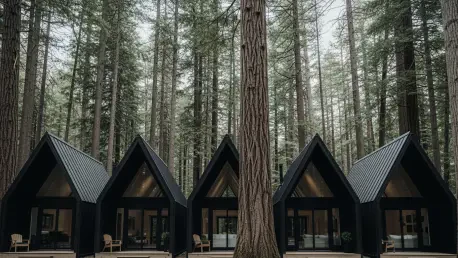
Unlike boutique hotels with limited footprints, this retreat is built for scale, featuring three primary lodges and eight detached A-frame cabins that can house up to 240 guests. Sunrise Lodge acts as the operational hub with twenty-two rooms and a large meeting hall, alongside specialized staff housing and communal kitchens. The infrastructure is designed to handle high-occupancy events, making it one of the few locations in the region capable of hosting such large groups.
Because the property is not tied to a specific hotel brand or management firm, an owner has the creative freedom to pivot the business model. The campus can easily be reimagined as a high-end corporate retreat center, a specialized youth summer camp, or a modernized boutique resort. This lack of branding allows for a flexible commercial strategy that can adapt to changing market demands without the cost of franchise fees or restrictive corporate mandates.
The Competitive Edge: High Barriers to Entry in Federal Land Tourism
One of the most compelling aspects of this investment is its operation under a 20-year U.S. Forest Service special-use permit, which creates a significant “moat” around the business. This permit effectively prevents competitors from developing similar large-scale facilities on the surrounding federal land, granting the owner a near-monopoly on high-capacity lodging in the immediate vicinity. Such regulatory protection is invaluable in a market where land-use restrictions are increasingly stringent.
The facility has already demonstrated its versatility by serving as a master-leased housing solution for resort staff, proving that the demand for the space exists across multiple sectors. This established operational history provides a layer of security for new owners, showing that the property can generate revenue even outside of traditional leisure travel. The combination of regulatory protection and functional flexibility makes it a resilient asset against typical market fluctuations.
Strategic Acquisition: Leveraging Seller Financing and Diversified Revenue Streams
Navigating the purchase of such a specialized asset was made more accessible by the inclusion of potential seller financing in a first-position arrangement. This financial structure allowed the investor to secure the property while focusing capital on modernizing the site or rebranding the guest experience. It provided a structured path for acquisition in a high-demand tourism market where traditional commercial lending might be more complex due to the unique nature of the land permit.
To maximize the long-term return on investment, the owner implemented a tiered revenue strategy that utilized the campus for lucrative corporate mid-week bookings while reserving weekends for high-occupancy leisure travel. The facility eventually served as a diversified asset that captured various market segments successfully, from seasonal outdoor events to professional retreats. By diversifying these revenue streams, the retreat transitioned into a sustainable and highly profitable hospitality model that capitalized on its unique forest location.