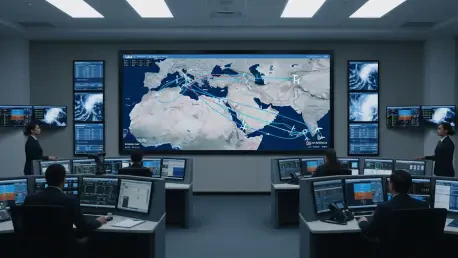

A sweeping wave of flight cancellations and operational changes has cascaded across the global aviation industry, effectively isolating Israeli airspace as major international carriers respond to a sharp escalation in Middle Eastern geopolitical tensions. A comprehensive analysis published in January 2026 reveals a coordinated, albeit varied, retreat from the region by a growing list of prominent airlines, including Emirates, United Airlines, Air Canada, and the Lufthansa Group. This widespread industry shift underscores a stark consensus: in the face of a volatile and unpredictable security landscape, the safety of passengers and crew must supersede all other operational considerations. The decisions, ranging from complete service suspensions to complex rerouting maneuvers, paint a picture of an industry on high alert, navigating an increasingly hazardous environment with extreme prejudice and a clear focus on risk mitigation. The actions taken by these carriers signal not just a temporary disruption but a fundamental reassessment of the viability of commercial air travel through critical Middle Eastern corridors, creating significant uncertainty for travelers and highlighting the profound impact of regional instability on global connectivity.
The Driving Forces Behind Aviation’s Retreat
Geopolitical Risks and Official Warnings
The primary catalyst for the widespread flight adjustments is the alarming escalation of geopolitical instability throughout the Middle East, with a particular focus on the deteriorating relationship between the United States and Iran. This strained dynamic has resulted in heightened military posturing and a tangible increase in the risk of open conflict, directly compromising the perceived safety of key international air corridors that traverse the region. Airlines are not merely reacting to speculative threats but to a credible and developing security crisis that makes routine operations untenable. The presence of advanced military hardware and a state of high alert among regional powers transforms the airspace into a potential conflict zone where the margin for error is nonexistent. This environment has forced carriers to re-evaluate their risk calculus, concluding that the potential for a catastrophic incident, however remote, outweighs the commercial imperatives of maintaining established routes. This fundamental shift in risk assessment is the bedrock upon which all subsequent operational decisions have been built, from minor schedule changes to complete withdrawals from the market.
Further compounding the situation, a significant common theme influencing these decisions is the direct impact of stern advisories issued by international aviation safety regulators. The European Union Aviation Safety Agency (EASA), alongside other influential global bodies, has circulated critical warnings concerning the airspace over and in proximity to Iran. These advisories specifically highlight a severe and unacceptable risk of “misidentification” of civilian aircraft by military air defense systems, a danger that has become a primary driver for immediate and drastic risk-mitigation strategies. The potential for military action and unresolved disputes over the control of specific Flight Information Regions (FIRs) has rendered certain air routes too hazardous for routine commercial flights. These official warnings provide airlines with the necessary justification and impetus to implement what might otherwise be seen as drastic measures. The regulatory guidance effectively removes ambiguity, framing the decision to alter or suspend flights not as a choice but as a necessary compliance with global safety standards in the face of a clearly articulated threat.
Economic Pressures and Operational Hazards
Beyond the immediate and most critical safety concerns, a powerful undercurrent of financial pressure is significantly influencing airline decisions. The global aviation insurance market, a sector highly sensitive to geopolitical risk, has reacted swiftly to the heightened instability by substantially increasing premiums for any carrier operating in or near designated conflict zones. These revised insurance rates are not arbitrary; they are based on sophisticated actuarial models that reflect a higher statistical probability of incidents, disruptions, or even catastrophic accidents. This translates directly into a surge in operational costs for airlines, making flights through the region less commercially viable. This economic factor, when combined with the paramount safety concerns, creates an undeniable and powerful incentive for airlines to either suspend services entirely or reroute them along safer, albeit more costly and longer, flight paths. The financial burden acts as a secondary confirmation of the risk, reinforcing the decision to prioritize safety by making the alternative economically punitive.
The operational environment itself has become fraught with hazards that extend beyond the risk of direct military engagement. The significant and visible increase in military presence throughout the Arabian Gulf and a general state of heightened military readiness across the region introduce a complex layer of operational risk. This includes the potential for sudden airspace closures with little notice, communication jamming, and the unpredictable movements of military aircraft and naval vessels. These factors create an environment where the continued, unaltered operation of scheduled commercial flights becomes a high-stakes gamble. For major international airlines, whose brands are built on foundations of safety and reliability, such a gamble is simply unacceptable. The cumulative weight of these operational hazards, from unpredictable military drills to the sheer density of military assets in key corridors, makes the decision to divert or suspend flights a logical and prudent response to an environment where the normal rules of civil aviation no longer fully apply.
A Spectrum of Responses How Airlines are Adapting
Total Suspension The Most Cautious Stance
An analysis of the collective actions taken by global carriers reveals that the most risk-averse response has been the complete and indefinite suspension of services to the affected region. This approach, representing the most cautious stance, has been adopted by prominent airlines such as United Airlines and Air Canada, which have opted for a full halt of all flights to Tel Aviv. This decisive measure indicates that, based on their comprehensive internal risk analysis and the available intelligence from governmental and aviation safety bodies, the current security environment poses an unacceptable level of danger for their passengers, crew, and aircraft. By ceasing operations entirely, these airlines eliminate all exposure to the regional risks, providing absolute clarity to their customers and stakeholders. Passengers with existing bookings are typically offered full refunds or flexible rebooking options for a future, yet-to-be-determined date, underscoring the indefinite nature of the suspension.
The decision to implement a total suspension carries significant implications beyond immediate passenger disruption; it signals a deep-seated, long-term concern about the stability of the region rather than a reaction to a temporary threat. This move reflects a strategic assessment that the underlying conditions creating the risk are not expected to resolve quickly. For the airlines, it involves complex logistical challenges, including the repositioning of aircraft and crew and the absorption of significant revenue losses from what are often lucrative international routes. For the traveling public and the business community, it represents a major disruption to connectivity, severing vital air links between continents. The gravity of such a decision cannot be overstated, as it publicly frames the region as a no-go zone from the perspective of some of the world’s most safety-conscious carriers, influencing the perceptions and decisions of other industry players and international travelers alike.
Modified Operations A Calculated Risk
In contrast to the all-or-nothing approach of total suspension, a significant number of European carriers have adopted a more nuanced strategy, choosing to modify their schedules and operational procedures to mitigate specific, identified risks. This method of calculated risk management is exemplified by the actions of the Lufthansa Group, which includes Lufthansa, SWISS, and Austrian Airlines, as well as Spain’s flag carrier, Iberia. These airlines have strategically shifted their services to Tel Aviv to daytime-only operations. This decision is directly based on a detailed risk assessment concluding that the danger of an aircraft being misidentified by military air defense systems is significantly higher during nighttime hours due to reduced visibility and other operational factors. By canceling all overnight flights, these airlines aim to maintain a crucial air bridge to Israel while minimizing their exposure to the most acute and well-defined dangers. This approach allows them to continue serving the market and accommodating passengers, albeit with a reduced schedule and less flexibility.
This trend of operational modification also includes other forms of temporary and partial adjustments, demonstrating a flexible, wait-and-see approach. British Airways, for instance, has implemented a temporary suspension of certain flights on its Tel Aviv route while committing to a continuous, daily re-evaluation of the security situation. This rolling assessment allows the airline to respond dynamically to any changes on the ground or in the airspace, scaling its operations up or down as conditions permit. This strategy differs from the daytime-only model by being more fluid and less structurally defined, offering the airline the agility to reinstate services quickly if the perceived threat level decreases. For passengers, this means a higher degree of uncertainty, as flight statuses can change with little notice. However, it also reflects an airline’s commitment to maintaining service where possible, carefully balancing its safety obligations with its commercial commitments in a highly volatile environment.
Strategic Rerouting Maintaining Connectivity at a Cost
A third distinct trend, most prominently observed among major Gulf carriers and other airlines with extensive global networks, involves the strategic rerouting of flight paths to maintain service while avoiding hazardous airspace. Airlines such as Emirates, Flydubai, and the European low-cost carrier Wizz Air have chosen not to suspend flights to Tel Aviv but have instead implemented significant and complex rerouting of their established flight paths. These meticulous adjustments are designed to completely bypass high-risk zones, particularly the airspace over Iran and other sensitive areas. This strategy ensures the continuity of service, which is vital for these airlines as they function as major global hubs connecting east and west. By rerouting, they can continue to offer flights to their destinations, upholding their network integrity and continuing to serve passengers who rely on these critical links for business and personal travel. This approach prioritizes connectivity while adhering strictly to safety mandates.
However, the decision to maintain service through rerouting comes at a considerable cost and introduces a new set of operational complexities. The most immediate and noticeable consequence for passengers is a significant increase in flight durations, which can add several hours to a journey. These longer routes directly translate to increased fuel consumption, driving up operational costs for the airlines. For some carriers, the extended flight paths necessitate additional logistical measures. Wizz Air, for example, has had to implement technical stops for refueling in locations like Larnaca, Cyprus, or Thessaloniki, Greece, for its Westbound Gulf routes. These stops add further time and complexity to the journey, potentially leading to cascading delays across the network. While this strategy successfully mitigates the primary security threat, it highlights the significant trade-offs required to operate safely in the shadow of regional conflict, impacting everything from airline profitability to the passenger experience.
Airline Specific Actions A Global Coordinated Reaction
North American and Gulf Carriers Decisive Measures
The response from North American carriers was swift and decisive, setting a cautious tone for the global industry. United Airlines became one of the first major U.S. carriers to take definitive action, announcing on January 22, 2026, an indefinite suspension of all its flights to Tel Aviv. The airline explicitly cited escalating security risks and official aviation advisories as the basis for its decision, prioritizing safety above all else and offering full refunds or rebooking assistance to all affected customers. Following this lead, Air Canada announced the suspension of its Tel Aviv services starting on January 23, 2026. The Canadian airline’s decision was similarly driven by profound concerns over airspace safety and the unstable political climate, with a clear commitment to resume flights only when conditions are deemed unequivocally safe by both internal and external experts. These actions sent a powerful signal about the perceived severity of the risk from a North American perspective.
In the Gulf region, where proximity to the tensions is a daily operational reality, carriers have focused on strategic adjustments to maintain their hub-and-spoke models safely. Effective January 25, 2026, the Dubai-based carrier Emirates began rerouting its flights to avoid higher-risk airspace, particularly over Iran. While it continues to operate services to Tel Aviv, the airline has publicly advised passengers to expect extended travel times and potential delays as a direct result of these necessary safety precautions. Similarly, Flydubai, another major airline based in Dubai, took a dual approach as of January 22, 2026. It suspended its services to several Iranian cities, including Tehran, Mashhad, and Shiraz, to eliminate direct exposure, while simultaneously rerouting its ongoing flights to Tel Aviv to bypass impacted Flight Information Regions (FIRs) and ensure the safety of its operations.
European Carriers Nuanced Strategies
European airlines have largely implemented a range of nuanced, risk-based adjustments rather than outright, indefinite suspensions. Leading this moderated response, the Lufthansa Group, which encompasses Lufthansa, SWISS, Austrian Airlines, and Brussels Airlines, implemented a policy of operating only daytime flights to Tel Aviv as of January 20, 2026. All scheduled night flights were canceled through the end of January, with the airline group continuously assessing the situation to determine future schedules. This strategy was mirrored by Spain’s Iberia, which announced on January 22, 2026, that it would suspend all night flights on its Madrid–Tel Aviv route, restricting service to daylight hours in a direct response to heightened security alerts from global aviation authorities. This coordinated shift to daytime operations reflects a shared European assessment of where the most acute risks lie.
Other European carriers have adopted hybrid or flexible approaches. On January 21, 2026, the Dutch airline KLM took a combined approach, canceling some of its scheduled flights to Tel Aviv to reduce its overall exposure while rerouting its remaining services to avoid Iranian airspace. This has resulted in a reduced schedule and longer flight times for the services that continue to operate. Meanwhile, British Airways initiated a temporary suspension of several flights to Tel Aviv beginning January 20, 2026. The airline is reviewing the security situation daily, characterizing the changes as short-term adjustments. This flexible posture allows it to offer options to impacted passengers while closely monitoring developments, ready to scale operations back up if conditions improve. This variety of responses from European carriers highlights a continent-wide effort to balance safety imperatives with the desire to maintain essential air connectivity.
The Ripple Effect on Regional and Low Cost Carriers
The disruption caused by the regional tensions has not been confined to major legacy carriers; its ripple effects have been felt across the industry, impacting low-cost carriers and regional airlines as well. On January 19, 2026, the European low-cost airline Wizz Air began adjusting its Westbound Gulf routes to avoid high-risk zones. The implementation of these rerouted paths has been operationally demanding, necessitating technical and refueling stops in intermediate locations like Larnaca, Cyprus, and Thessaloniki, Greece. These additional stops, while ensuring safety, significantly increase overall journey times and add a layer of complexity to the airline’s point-to-point business model, challenging its ability to offer the low fares and quick turnarounds it is known for. This demonstrates that even airlines without the extensive hub-and-spoke networks of legacy carriers are forced to make costly and disruptive adjustments.
Furthermore, the impact has extended to carriers not directly serving Israel, highlighting the interconnected nature of regional airspace. India’s largest airline, IndiGo, suspended several of its routes beginning January 18, 2026. Although these routes did not terminate in Israel, services to destinations such as Almaty, Baku, Tashkent, and Tbilisi were paused due to the significant operational difficulties and extended travel times caused by the necessary avoidance of Iranian airspace. The inability to use these established and efficient flight paths made the routes commercially and logistically unviable. This domino effect illustrates how a crisis in one specific corridor can have far-reaching consequences, disrupting travel and trade across a much wider geographical area and forcing airlines to make difficult decisions about their entire regional network strategy.
Navigating the Path Forward
The aggregated information from across the aviation sector presented a clear and unified message: the international airline community exercised extreme caution in response to what was perceived as a tangible and elevated threat level in the Middle East. The consistent pattern of actions across multiple carriers, from complete flight cancellations to strategic rerouting and schedule modifications, reflected a deep-seated and non-negotiable commitment to passenger and crew safety. For travelers, the immediate consequence was a period of significant disruption and uncertainty. The fluid and developing nature of the geopolitical situation meant that further operational changes could, and often did, occur with very little notice. This environment necessitated a high degree of flexibility and proactivity from the traveling public, who were advised to maintain constant communication with their respective airlines and regularly check for updates on flight statuses. The events of January 2026 served as a stark reminder of how quickly global connectivity can be impacted by regional instability.