
Travelers who sprinted past food courts now linger for craft coffee, chef-led bites, and local stories stitched into concourses, and that shift set the stage for a high-stakes dining refresh at JetBlue’s Terminal 5. Commentators across aviation retail agreed that T5 needed a program that reads New York at a glance while still moving lines at peak banks. The consensus framed SSP America’s multi-unit win as the lever to fuse identity with efficiency, not a tug of war between them.
Analysts who track terminal mix pointed out that the scope—more than 10 venues—signals intent beyond a facelift. In their view, scale lets a developer orchestrate variety, deploy shared logistics, and shape guest flow, turning a terminal from an unavoidable waypoint into a place people remember. Others noted the national trend: airports that curate local voices but retain reliable anchors see higher dwell satisfaction and steadier spend.
Previewing the rollout, several sources emphasized three threads to watch: the brand recipe that pairs city originals with household names, the sense-of-place design running from security to gate, and the operational handshake between SSP America and Fraport USA. Together, they argued, those elements set the terms for how travelers will eat, linger, and share during the phased opening through 2026.
The strategy behind the win—and what travelers will experience
Curating a “taste of place” without sacrificing convenience
Menu strategists praised the calibrated lineup that blends Jacob’s Pickles, Leon’s Bagels, Mister Paradise, Tiki Chick, Birch Coffee, Juice Press, The Gotham Burger Social Club, Threes Brewing, and Blind Barber with Dunkin’ and Shake Shack. In their reading, that mix invites discovery while protecting familiarity, which matters when a red-eye crowd wants speed and a mid-morning wave wants a treat.
Comparing case studies, airport consultants pointed to terminals where local heroes sit beside national anchors and noted measurable lifts in check average and sentiment. They argued that authenticity, diversity, and service quality turn food into a competitive edge, especially when layovers stretch and travelers scroll for something distinctly of the city.
Skeptics raised practical flags: cult favorites can buckle under volume, national names can flatten local character, and brand integrity can fray when kitchens chase throughput. Proponents countered that throughput modeling, tight menus, and clear brand guidelines reduce that risk, keeping pace and place in balance.
Designing the journey: from concourse park vibes to memorable hospitality
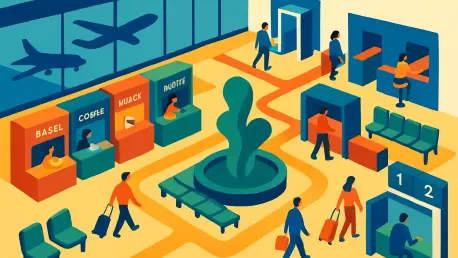
Design voices highlighted T5’s park-inspired central concourse and new public art as more than décor; they saw a narrative spine that ties concessions to movement. By clustering quick-service near high-traffic nodes and placing lounge-like bars and roasters by hold rooms, the plan aims to catch both sprinting flyers and dwellers without forcing either to compromise.
Operational designers added that clear wayfinding, lighting cues, and sightline management can shorten the perceived wait and steer guests toward open capacity. They argued that when the environment softens stress, hospitality lands better, and a simple bagel or coffee feels elevated.
However, peak banks remain unforgiving. Tech advocates pressed for queue visualization, pre-order rails, and mobile pickup shelves to keep lines visible yet fluid, noting that crowding erodes NPS fast. The opportunity, they said, is sharper per-passenger spend and social buzz when experiences feel seamless.
Operations and partnerships: SSP America, Fraport USA, and continuity at JFK
Operations specialists framed the partnership between SSP America and Fraport USA as the quiet engine behind the guest-facing polish. Standardized training, pooled back-of-house support, and shared receiving were cited as the tools that make 10-plus brands act like one orchestra rather than a noisy jam session.
Looking across multi-operator terminals, several observers reported that strong developer coordination shortens ramp-up, steadies supply lines, and narrows variance in food safety and speed. Continuity at JFK, they added, keeps institutional knowledge in play, which matters when storms snarl schedules and deliveries.
Even fans of the model acknowledged hard work ahead: airside deliveries must thread congestion, specialized concepts need skilled staffing, and openings will phase through 2025 with completion by late 2026. The goal, they said, is to stage growth without tripping day-to-day service.
The airport dining arms race—and how T5 aims to pull ahead
Trend watchers saw the same pattern cropping up nationwide: curated local lineups, chef-led bars, craft coffee, premium fast casual, and mobile-first ordering. Within that movement, T5’s advantage is New York’s deep bench—chefs, roasters, and brewers who can scale while staying true to the city’s voice.
Some predicted limited-time collabs tied to big-city moments and brand pop-ups that reward frequent flyers with novelty. Others cautioned against constant churn, arguing that consistency builds trust when flight plans change and appetite windows shift by the hour.
A shared conclusion surfaced: the old belief that speed requires generic menus is fading. Tight SKUs, tech-enabled kitchens, and disciplined workflows can deliver pace and place-making at once, giving terminals like T5 a way to serve both the clock and the craving.
What to take away—and how to apply it
Across interviews and analyses, one throughline stood out: T5’s refresh uses city-first storytelling backed by operational rigor. The brand mix invites exploration for those with time, while anchors meet the need for quick, no-risk orders. That duality aligns with what travelers say they want—variety without guesswork.
Practitioners offered clear tactics that any terminal can lift: anchor with a few national names, then surround them with distinctive local concepts; invest in queue tech, pre-order, and readable digital signage; standardize the back-of-house to protect speed while giving each front-of-house its own personality; and weave art and design cues to bind the program into a single experience.
Measurement came up often. Teams recommended tracking throughput, guest sentiment, check average, and repeat visitation, then flexing menus and dayparts based on real-time patterns. In short, treat the terminal like a living storefront, not a fixed build-out.
The road ahead for T5—and a broader signal to U.S. airports
Industry voices agreed that SSP America’s win, guided with Fraport USA, positioned T5 to showcase New York flavor, traveler-first service, and scalable operations. The program’s depth gave the terminal latitude to tune choice by time of day, weather swings, and demand spikes without losing its story.
As additional units opened through 2025 and the full slate targeted late 2026, T5 offered a template: differentiate with local culture, stabilize with reliable anchors, and defend speed with smart systems. Competing hubs watched because the playbook balanced aspiration with execution.
For readers seeking next moves, experts pointed to studying brand adjacency maps, piloting mobile pickup before peak season, and building collaboration frameworks that lock training and logistics early. This roundup closed on a pragmatic note: the strongest terminals treated dining as a service and a stage, and T5 showed how that approach could scale.