
While many travelers dream of sun-drenched Italian piazzas, the elegant ducal city of Turin, nestled at the foot of the Alps, reveals its most profound and authentic character under the crisp, cold veil of winter. When the summer crowds have long dispersed and a quiet chill settles over the baroque porticoes, Italy’s first capital awakens with a series of deeply rooted traditions that are as warming as they are vibrant. February, in particular, transforms this industrial and cultural hub into a stage for communal celebration, where the aromas of chocolate, mulled wine, and hearty cuisine fill the air. It is a time when the city is not for tourists but for the Torinese, offering a rare opportunity to experience its culture not as a spectacle, but as a living, breathing entity. This period demonstrates that for those seeking an immersive Italian experience, the supposed “off-season” is, in fact, the most rewarding time to visit.
Escaping the Off-Season Myth to Uncover a City Alive with Tradition
The conventional narrative of Italian travel often relegates the winter months to a secondary choice, a compromise made for lower prices and fewer people. This perception, however, overlooks the unique cultural tapestry that unfolds in cities like Turin when the temperatures drop. The modern traveler, increasingly searching for genuine connection over curated photo opportunities, will find that Turin’s frigid air acts as a preservative for its most cherished rituals. Far from being a hindrance, the cold encourages a communal spirit, drawing people together into historic cafés, bustling markets, and lively festivals that are integral to the city’s identity.
This pursuit of authenticity aligns perfectly with what a Torinese winter offers. The season strips away the superficial layers of peak-season tourism, revealing a daily life rich with sophisticated customs and centuries-old traditions. The experience is less about seeing the sights and more about participating in the city’s rhythm, whether through the shared warmth of a communal meal or the collective cheer of a neighborhood parade. In February, Turin is not dormant; it is intensely and unapologetically itself, providing a vibrant counter-narrative to the myth of a hibernating Italy.
A Month of Fire and Ice Through February’s Festivities
The first part of the month is animated by the spirit of Carnival, which in Turin unfolds not as a single, monumental event but as a series of intimate, neighborhood-level celebrations. A key hub of this activity is the historic Balôn antiques market in Piazza Borgo Dora. Here, amid rows of vintage treasures and historical curiosities, the festival comes alive with reenactments featuring figures from Roman to Savoyard times. The local Carnival mask, the Rusnenta, whose name translates from the local dialect as “the rusted one,” pays homage to the area’s heritage as a center for antiques and second-hand goods. The city’s official Carnival characters, the sharp-witted Gianduja and his companion Giacometta, are ubiquitous, their presence culminating in a grand finale on the River Po, where a masked procession of boats glides majestically toward the Murazzi riverfront.
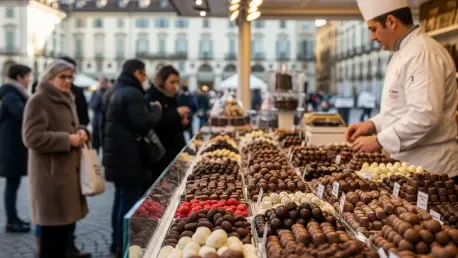
As the energy of Carnival subsides, the city’s focus shifts seamlessly to its most celebrated culinary treasure: chocolate. The annual CioccolaTò festival transforms the expansive Piazza Vittorio Veneto into a paradise for cocoa lovers, with stalls from Piedmontese and international chocolatiers offering endless tasting opportunities. This event is a modern celebration of a deep-rooted history that established Turin as Italy’s chocolate capital in the 17th century. It was here, in the early 19th century, that local artisans ingeniously blended scarce cocoa with local hazelnuts to create gianduja. The iconic chocolate born from this paste, the giandujotto, was first distributed during Carnival, its shape cleverly designed to mimic Gianduja’s tricorn hat, forever linking the city’s festive and culinary traditions.
The month concludes with a tribute to another of Turin’s signature creations: vermouth. The Salone del Vermouth, held at the Museo Nazionale del Risorgimento Italiano, is the centerpiece of a city-wide celebration of the aromatic fortified wine first codified here in the 18th century. In the days leading up to the main event, a program of talks, masterclasses, and special cocktail menus enlivens bars and cultural venues across the city. For those wishing to delve deeper, historic producers like Museo Carpano and Casa Martini open their doors for tours and tastings. Running concurrently, the Salone del Vino gathers hundreds of regional producers, offering a comprehensive showcase of Piedmont’s world-renowned viticulture, from the powerful reds of Barolo and Barbaresco to delicate alpine varietals.
Voices of Turin on Winter’s Enduring Appeal
The profound connection between Turin’s winter and its culinary traditions is deeply felt by its residents. Chocolatier Grazia Carelli notes that the season awakens a natural craving for comfort. Rich, indulgent treats, she explains, do more than satisfy a simple hunger; they “fill the spirit, the heart and the body.” This sentiment is particularly true for shared experiences like enjoying a creamy hot chocolate, a ritual that provides warmth and connection during the coldest days of the year.
This appreciation for deliberate, shared moments is also central to the city’s sophisticated aperitivo culture. Laura Carello, founder of the Salone del Vermouth, distinguishes the Torinese ritual from the more hurried versions found elsewhere in Italy. Here, the aperitivo is a “slower, more deliberate part of the day,” a refined social custom where the accompanying food is designed to complement the drink, not merely precede a meal. This practice evolved from the rural merenda sinoira, a hearty late-afternoon meal that the Savoyard court transformed into an elegant urban tradition.
Perhaps no dish better encapsulates the communal warmth of a Turin winter than bagna cauda. This iconic meal, featuring a steaming pot of garlic-and-anchovy sauce for dipping seasonal vegetables, is more than just food; it is a profoundly social experience. It is a dish that, as locals describe it, “brings everyone back to the hearth,” fostering a sense of togetherness and shared comfort that is the very essence of the season.
A Practical Guide to a True Torinese Winter
To fully embrace the season, one must indulge in the region’s hearty cuisine, which is perfectly engineered for cold weather. Restaurant menus feature comforting staples like fonduta, a rich melted cheese dip often served with pasta or vegetables, and gran bollito misto, a ceremonial assortment of slow-simmered meats paired with piquant sauces. Another quintessential main course is veal brasato al Barolo, where the tender meat is braised in the region’s most famous wine. No visit is complete without tasting the city’s signature drink, the bicerin. This layered concoction of espresso, hot chocolate, and cream is best enjoyed at its 18th-century birthplace, Caffè Al Bicerin. For dessert, the bunet, a dense chocolate and amaretto pudding, offers a perfect, sweet conclusion to a winter meal.
For those seeking an exhilarating cultural experience, a short train ride to the nearby town of Ivrea is essential. Its historic Carnival is famous for the Battle of the Oranges, a chaotic and thrilling reenactment of a medieval revolt. Over three days, teams of orange throwers on foot engage in a symbolic fight against rivals in horse-drawn carts. Visitors are advised to wear a red Phrygian cap, the berretto frigio, which signals neutrality and protects them from the crossfire. Dressing warmly and enjoying a cup of vin brûlé, Piedmont’s version of mulled wine, are also key to enjoying this unique and boisterous tradition.
Navigating Turin’s cultural offerings is made easy with unique transport and dedicated museums. The Choco Tram offers a scenic journey on a vintage streetcar from the city center to Choco-Story Torino, an interactive museum that explores the history of cocoa and Turin’s central role within it. Meanwhile, aficionados of fortified wines can plan visits to historic vermouth houses like Museo Carpano and Casa Martini. These institutions offer guided tours detailing the production process from herb infusion to bottling, culminating in expertly led tastings that provide a deep appreciation for this iconic Torinese creation.
This journey through Turin in February revealed a city that thrives in the cold, its identity sharpened by the crisp winter air. The convergence of Carnival’s communal joy, the rich indulgence of its chocolate heritage, and the sophisticated ritual of the aperitivo offered a portrait of a place deeply connected to its traditions. Experiencing these customs was not about observing from a distance but about participating in a rhythm of life that felt both timeless and vibrantly present. The hearty flavors of its cuisine and the raw energy of nearby festivities provided a compelling argument that to truly understand this elegant Italian city, one had to embrace it during its most authentic season.