
Across studios and venues, employers describe a stubborn mismatch: productions need multi-skilled makers while learners still navigate fragmented routes with little proof of job readiness. That tension sharpened during Creative Careers Month, when the conversation turned from abstract pipelines to practical, paid pathways.
Industry leaders frame DRPG’s move as a timely correction. A Level 3 pathway that blends carpentry, technical drawing, and metalwork aligns with how shows are actually built, not how courses have long been segmented. Educators also welcomed a model that shows clear progression into real roles rather than vague creative futures.
Observers connected the launch with an equally hands-on careers experience. By pairing a formal qualification with Sparks Live immersion, DRPG stitched training to practice, giving candidates a route to learn, test, and apply—without losing sight of safety, budgets, or deadlines.
Inside a two-track strategy that blends qualifications with immersion
Commentators noted that the strategy rests on mutual reinforcement: structured learning develops core competencies, while immersion days stress time pressure, collaboration, and problem-solving. Together, they model the conditions of live, film, digital, and scenic work.
Another theme was clarity. Participants saw how roles interact, how designs convert into drawings, and how drawings become steel and timber on a bench. That end-to-end visibility, reviewers argued, reduces attrition and speeds fit-for-purpose placement.
The UK’s first Scenic Construction Technician Apprenticeship: one pathway, three crafts, real outcomes
Apprenticeship specialists praised the integrated syllabus shaped with Creative Alliance and Skills England, pointing out that DRPG’s in-house model demands cross-training as the norm. Becky Cubitt emphasized the portability of skills across venues, which employers interpreted as a hedge against volatile demand.
Learners highlighted Dash Hingley’s view: hands-on build time from design through installation changes confidence and pace. Yet practitioners debated scope creep, warning that breadth must not dilute standards, and urged robust assessment to uphold safety and finish quality while learning accelerates.
From bench to venue: mapping multidisciplinary training to the jobs people actually do
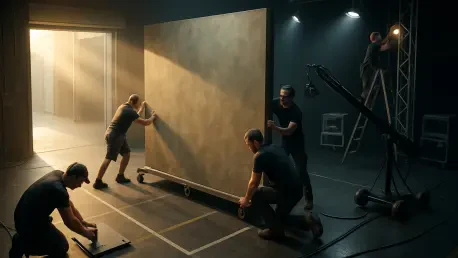
Production managers valued how graduates could move from workshop fabrication to theater fit-ups, studio shoots, events, or touring builds without a reset. Reviewers cited cross-team jobs where scenic integrates with film units or live control, compressing schedules while preserving craft.
However, master carpenters stressed the enduring need for depth. Their consensus: early breadth grants adaptability; later specialization secures excellence. Employers saw competitive advantage in crews that flex across phases, provided mentoring and quality checks remain tight.
Sparks Live at Hartlebury: immersion, AI, and showtime sprints that decode creative careers
Educators described Sparks Live as a decoder ring for creative work. Across brand storytelling, behind-the-scenes show builds, collaborative digital, AI-enhanced ideation, scenic craft, and a rapid newsroom film sprint, 180 students confronted the rhythm of real production.
Regional advocates highlighted Midlands access to industry-standard tools and workflows. Participants left seeing a grid of roles, timelines, and safety gates—not a single “creative” identity—making choices more informed and ambitions more grounded.
Building a talent ecosystem: NextGen leadership, partnerships, and scaling what works
Early-career voices credited the NextGen Board with peer-led relevance, noting that Hingley’s workshop drew more than 150 participants by translating theory into tactile wins. That energy, reviewers said, turns interest into intent.
Policy watchers contrasted DRPG’s model with siloed training. They encouraged modular credentials, micro-badges, and employer co-assessment to scale quality while keeping speed. Partnerships with sector bodies, they added, can expand placements and build regional hubs.
Turning insight into action: practical steps for employers, educators, and aspiring makers
Sources converged on a few moves. Co-design curricula with employers, embed live briefs, and rotate apprentices across disciplines so safety, quality, and speed can be measured, improved, and shared.
Studios and schools were urged to build pipelines from concept to stage, pairing AI tools with craft fundamentals. Pop-up immersion days tied to deliverables—finished flats, rigged truss, or a cut-and-finished metal frame—make progress visible and standards tangible.
The road ahead: keeping creative careers tangible, inclusive, and future-proof
Commentators agreed that the apprenticeship plus Sparks Live formed a throughline from learning to doing. Cross-functional fluency, transferable skills, and exposure to real constraints strengthened resilience across roles and sectors.
The roundup closed on action: expand placements with co-assessed milestones, invest in mentors who bridge breadth and depth, and track outcomes that matter to employers. For further reading, panelists pointed to guidance on hybrid skills assessment, case studies on AI in production design, and toolkits for running industry-grade immersion days.