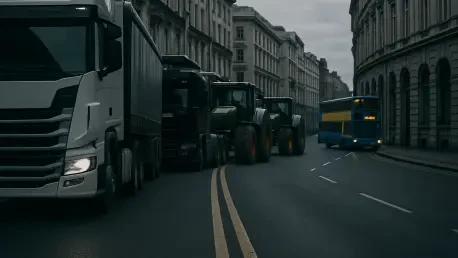

The sudden transformation of Dublin’s bustling O’Connell Street into a static graveyard of heavy machinery has sent shockwaves through the capital’s entire logistical framework. This unprecedented demonstration, led by a coalition of hauliers and farmers, serves as a stark reminder of how vulnerable modern urban transit systems are to targeted social disruption. For six consecutive days, the primary arteries of the city have been effectively severed, leaving the Dublin Bus network in a state of operational paralysis that defies standard emergency protocols. While the protestors argue that the skyrocketing costs of fuel have left them with no alternative but to blockade the city’s veins, the immediate consequence is a total breakdown of movement for tens of thousands of daily commuters. This crisis represents a collision between socio-economic grievances and the physical realities of urban infrastructure, highlighting a fragility that few anticipated in a city so dependent on a centralized transport spine.
Economic Grievances: The Strategy of Blockage
The root causes of this urban standoff are found in the deep-seated economic frustrations of Ireland’s agricultural and logistics sectors, where participants claim that rising operational costs are no longer sustainable. By choosing O’Connell Street as their primary theater of operations, the demonstrators identified the most sensitive pressure point in the city’s infrastructure. This tactical selection was not accidental; the narrow corridors and historic bridges that define the city center provide a natural bottleneck that, when occupied by heavy trucks and tractors, renders the surrounding network useless. The strategy successfully converted essential work vehicles into tools of civil disobedience, effectively forcing the government to confront the reality of industry-wide financial strain. This method of protest demonstrates how a relatively small group of determined individuals can exert massive influence over a capital city by simply occupying the space where its vital public services must pass.
As the protest enters a new phase, the focus has shifted from the initial occupation to the grueling process of restoring order under the guidance of the Garda Síochána. Even as the core group of demonstrators begins to thin out, the physical presence of abandoned or stationary heavy vehicles continues to dictate the rhythm of the city. The transition from an active protest site to a cleared transit route is fraught with logistical challenges, as law enforcement must coordinate the removal of large-scale machinery in a dense urban environment. This period of transition is perhaps more chaotic than the protest itself, as the unpredictability of the clearing operation prevents Dublin Bus from establishing a reliable schedule. The operational paralysis is thus extended by the very complexity of the recovery effort, leaving the city in a state of suspended animation while specialized equipment is deployed to reclaim the streets for the public transport network.
The Truncation: Splitting the Urban Core
To mitigate the total failure of the network, Dublin Bus has been forced to implement a strategy of truncation, effectively splitting the city’s transit maps into two disconnected geographic spheres. This maneuver prevents buses from entering the high-risk zone monitored by the Gardaí, but it creates a massive dead zone in the heart of the capital where no public vehicles can traverse. Commuters traveling from the Northside find their journeys abruptly ended at Parnell Square or Mountjoy Square, far short of their intended destinations in the southern suburbs or the central business district. This forced disembarkation creates a secondary crisis of pedestrian congestion, as thousands of people are dumped onto the sidewalks to navigate the final miles of their commute on foot. The resulting fragmentation of the network means that the traditional north-south connectivity of the city has been temporarily abolished, forcing a reliance on alternative, often less efficient, means of travel.
Simultaneously, services arriving from the Southside and affluent coastal regions are being turned back at St. Stephen’s Green or the RDS in Ballsbridge, further cementing the divide. This geographic isolation of the southern corridors is particularly disruptive for those who rely on cross-city routes to reach hospitals, universities, and government offices located north of the Liffey. The truncation strategy is a pragmatic response to an impossible situation, yet it highlights the lack of resilient infrastructure capable of bypassing the city center. By cutting the lines at these specific perimeters, Dublin Bus is essentially retreating from the urban core to protect its fleet and maintain some level of service in the outer suburbs. However, this retreat leaves a massive vacuum in the middle of the city, illustrating how easily the primary transit spine can be fractured when a localized disturbance occurs at the city’s central crossing points.
Total Suspensions: The Impact of Suburban Isolation
The most severe consequence of the ongoing unrest is the total suspension of critical routes that simply cannot function without access to the blocked central corridors. A primary example is Route 11B, which provides a vital link between the southeastern suburbs and Phoenix Park, a service that has been completely withdrawn from the schedule in both directions. This total cancellation creates a void in the network that cannot be easily filled by diversions or alternative routes, as the specific path of the 11B relies on the now-impassable city center. For residents who depend on this line for their daily needs, the protest has effectively cut off their primary means of social and economic participation. This level of disruption goes beyond mere delay; it represents a complete loss of mobility for a significant portion of the population, emphasizing the high stakes involved when public transit becomes collateral damage in a socio-economic dispute.
These total withdrawals from the service schedule underscore the inherent vulnerability of Dublin’s highly centralized transit model, where almost every major route is funneled through a handful of streets. When these streets are compromised, the entire logic of the suburban feeder system collapses, leaving the outer reaches of the city in a state of isolation. For many communities, the bus is the only affordable and accessible link to the wider metropolitan area, and its absence is felt acutely in both economic and social terms. The crisis has revealed that without the central axis, the peripheral routes lose their utility, turning a localized protest on O’Connell Street into a region-wide emergency. This systemic fragility means that the impact of the civil unrest is felt far beyond the physical boundaries of the protest zone, as the ripple effects of route cancellations spread through the suburbs like a shockwave.
Navigational Tactics: Rerouting and Bridge Diversions
In an effort to maintain some semblance of cross-city movement, Dublin Bus has designed a series of intricate diversions that attempt to bypass the O’Connell Street bottleneck by utilizing westerly river crossings. Routes such as the 16, which serves as the essential link to Dublin Airport, have been rerouted via Church Street and Bridge Street to maintain a north-south connection. While these tactical shifts allow some buses to continue operating, they often result in massive delays as these smaller, secondary streets are overwhelmed by diverted traffic. The heavy bus traffic, forced onto roads that were never designed for such high volumes, creates a new set of logistical problems, including increased wear on infrastructure and heightened risks for pedestrians in these areas. These diversions represent a desperate attempt to keep the city moving, but they are a poor substitute for the high-capacity corridors that are currently out of service.
In the southern part of the city, the rerouting strategy has forced buses into complex loops through Westland Row and Merrion Square, as drivers attempt to navigate around the Garda cordons. Other services have been pushed onto the Cuffe Street and Kevin Street corridor, a move that bypasses the traditional heart of the city but adds significant time to every journey. These navigational changes require constant communication between drivers, dispatchers, and the public, yet the volatility of the situation on the ground means that a route available in the morning may be blocked by the afternoon. Passengers are left in a state of constant uncertainty, often finding themselves on buses that are wandering through unfamiliar neighborhoods as they seek a clear path across the city. This reactive posture is the only option available to the transit authority, but it underscores the immense difficulty of managing a large-scale bus network in the middle of a civil crisis.
Law Enforcement: The Path to Operational Recovery
The eventual restoration of the Dublin Bus network is now entirely dependent on the success of the ongoing Garda operation to reclaim the city center from the physical remnants of the protest. This is no longer a matter of political negotiation with hauliers or farmers but a technical challenge involving the safe removal of large vehicles and the clearing of debris. The national police service has established a rigorous protocol for securing O’Connell Street, which includes systematic sweeps to ensure that no hazards remain before public transport is permitted to return. Until law enforcement provides an official all-clear, Dublin Bus remains in a holding pattern, unable to commit to a return to regular service. This dependency on police maneuvers highlights the shift from a social crisis to a logistical one, where the timeline for recovery is dictated by the speed of heavy-duty recovery vehicles and safety inspections.
As the physical barriers are slowly removed, the city remains in a state of logistical limbo, with police checkpoints and recovery crews serving as the primary occupants of the urban core. The process of reopening the streets is slow and deliberate, designed to prevent a secondary surge of congestion or renewed protest activity. For the commuters waiting for their routes to return to normal, this period is characterized by a frustrating lack of clarity, as the Gardaí cannot provide a definitive end time for the operation. The transition from a protest site back to a functional transportation hub is a complex undertaking that requires the coordination of multiple municipal agencies. This phase of the crisis serves as a stark reminder that even after the voices of protest have faded, the physical and operational consequences of civil unrest continue to linger, dictating the movement of the city for days after the initial event.
Systemic Insights: The Future of Urban Mobility
The paralysis of Dublin’s bus network has provided a profound case study in the intersection of socio-economic volatility and urban infrastructure resilience. The fact that a localized demonstration could effectively sever the connections between the north and south of the city suggests that the current model of extreme centralization is no longer viable in an era of frequent social disruption. This crisis demonstrated how a small, strategically positioned group could exert a veto over the mobility of the entire capital, revealing a level of fragility that requires urgent attention from city planners and transit authorities. To prevent such a total collapse in the future, there is a clear need for decentralized transit hubs and a more robust network of bypass routes that do not rely solely on the city’s central spine. Developing these alternatives would ensure that even if one area is compromised, the rest of the network can continue to function.
The lessons learned from this week of instability suggested that the city must prioritize the creation of redundant transit corridors to protect against future blockades. Planners recognized that the heavy reliance on a few key bridges and streets made the entire network an easy target for those seeking to cause maximum disruption. Moving forward, the focus shifted toward diversifying the paths available to public transport and improving real-time communication systems that can guide passengers through complex diversions. By implementing more flexible routing strategies and investing in secondary infrastructure, the city can build a transport network that is capable of absorbing shocks rather than collapsing under them. The experience of the past six days was a difficult but necessary catalyst for a broader conversation about how to safeguard the vital movement of citizens in an increasingly unpredictable social landscape.