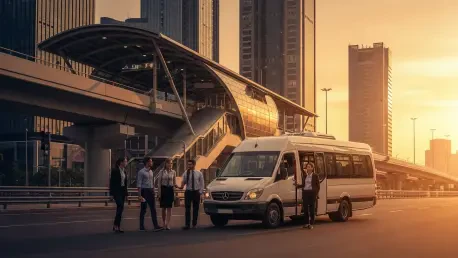

The rapid urbanization of modern metropolitan areas often leaves a significant gap between residential doorsteps and major public transportation arteries, a challenge that city planners frequently describe as the first- and last-mile problem. To address this discrepancy in the local landscape, the Dubai Roads and Transport Authority (RTA) recently announced the strategic expansion of its smart mobility network into four additional high-demand communities. Residents in Al Qusais, Jumeirah Village Circle, Al Warqa’a, and Dubai Investments Park now have access to a flexible transit solution that bridges the gap to metro stations and commercial hubs. This latest move brings the total coverage of the Bus-On-Demand service to 17 districts across the city. By deploying a fleet of 49 specialized minibuses, the initiative seeks to integrate disparate neighborhoods into a cohesive transit ecosystem. This growth reflects a commitment to making public travel more accessible to the diverse population residing in these developing areas.
Scaling the Digital Transit Infrastructure
The success of this initiative is deeply rooted in its departure from traditional, rigid transit schedules in favor of a dynamic, data-driven approach that responds to passenger needs in real-time. This model utilizes a sophisticated algorithmic system that calculates the most efficient paths based on active bookings made through a dedicated mobile application, thereby eliminating redundant stops and minimizing wait times. Recent performance metrics highlight the overwhelming public endorsement of this digital-first approach, with ridership skyrocketing from 417,315 in 2024 to 984,929 in 2025. This 136 percent increase suggests that commuters are increasingly prioritizing flexibility and technology over conventional bus routes. Moving forward from 2026 to 2028, the RTA intends to further refine these logistics by incorporating predictive analytics to anticipate peak demand periods. Such technological integration ensures that the fleet remains agile, maintaining a high level of operational efficiency even as the user base continues its exponential growth.
Sustainable Pathways for Urban Connectivity
Beyond the technological advancements, the financial accessibility of the service remained a cornerstone of its widespread adoption among the local workforce and student populations. With a standard fare of 5 AED and additional discounts for group bookings, the RTA effectively lowered the barrier to entry for shared mobility, encouraging a shift away from private vehicle reliance. This strategy aligned perfectly with the broader environmental goals of the city, focusing on the reduction of traffic congestion and carbon emissions through optimized vehicle occupancy. Strategic planners recognized that providing seamless transitions between various transport modes was essential for long-term urban sustainability. Consequently, they prioritized the integration of these micro-transit solutions with existing metro and marine networks to create a holistic travel experience. The expansion proved that flexible public transit could be both economically viable and socially impactful. Authorities subsequently recommended similar adaptive models for emerging smart cities to ensure that infrastructure growth consistently matched the evolving behaviors of modern commuters.