
With a rich background in the travel and tourism industry, Katarina Railko has become a key voice in entertainment and large-scale events. Her expertise in managing the complex logistics of expos and conferences gives her a unique perspective on the challenges and opportunities facing ambitious destination projects. We sat down with her to discuss how Red Sea Global is leveraging integrated digital platforms to manage its transformative hospitality developments, connecting thousands of stakeholders and setting a new standard for the industry.
Large-scale projects with geographically dispersed teams often struggle with fragmented systems. Can you describe the specific inefficiencies this created for RSG and how uniting over 23,000 users on a single platform will practically improve daily collaboration and reduce project risks?
You could almost feel the friction that fragmented systems created. When you have teams spread across different continents, siloed information is your worst enemy. It leads to a constant lag, where one team is waiting for data from another, or worse, working off outdated plans. This created genuine inefficiencies that threatened to cause serious project delays. By bringing all 23,000 users onto a unified platform like Oracle Aconex, you’re essentially creating a single source of truth. A field engineer in one location can access the exact same real-time project data as an executive in another. This immediate, shared visibility eliminates misunderstandings and dramatically accelerates the pace of collaboration, which in turn is one of the most effective ways to mitigate project risk.
With tools like Connected Cost and Model Coordination, how will the design and review process change for your global engineering teams? Please share a specific example of how this real-time data access will help you resolve a common issue more efficiently than before.
The change is revolutionary; it moves the process from reactive to proactive. In the past, a design clash identified by an engineering team would trigger a long, slow chain of emails and meetings across time zones. With Model Coordination, that same clash is flagged directly within the shared digital model for everyone to see instantly. But the real game-changer is linking it with Connected Cost. Now, when the design team proposes a solution, the project managers can see the immediate cost implications in real time. What used to be a week-long, back-and-forth debate about a design change can now be identified, resolved, and approved within a single day because all the critical data—the model, the comments, and the cost—is in one place.
Primavera P6 is set to centralize project scheduling and resource management. Could you walk us through how this unified approach will help you better mitigate risks and what key performance indicators you will track to ensure projects remain on time and on budget?
Centralizing scheduling with a powerful tool like Primavera P6 is like giving a ship captain a modern GPS instead of an old paper map. Previously, managing resources and schedules across such a massive portfolio was a constant challenge, making it difficult to spot potential bottlenecks until they were already causing delays. Now, we can run simulations and see the ripple effects of a decision before we even make it. This unified approach allows us to proactively manage our resources and timelines. The key performance indicators we’ll be watching like a hawk are schedule variance and cost performance. With real-time insights from the platform, we can see if a project is drifting off course immediately, not at the end of the month, allowing us to make swift, informed decisions to keep everything on track.
Integrating systems for project budgets, schedules, and workflows promises greater visibility. What kind of critical insights do you expect this will provide to executives versus field engineers, and how will it empower both groups to make faster, more informed decisions?
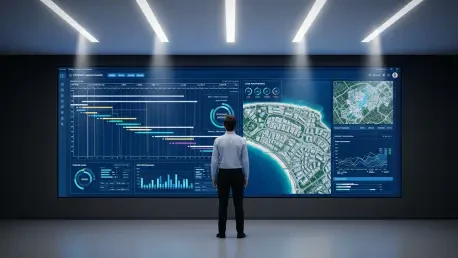
The beauty of this integration is that it delivers the right insights to the right people. For executives, it provides a high-level, real-time dashboard of the entire project portfolio. They can see the financial health and progress at a glance, giving them the confidence to make strategic decisions quickly. For the field engineer, the empowerment is just as profound but far more immediate. They can stand on-site, pull up a tablet, and know with absolute certainty they are looking at the latest approved drawing or workflow. This eliminates the huge risk of building from outdated plans. Ultimately, it empowers both groups by cutting through the noise and delivering clear, actionable information tailored to their roles.
Your team is implementing custom workflow automation for document approvals and cost controls. Can you provide an anecdote about a process that was previously a bottleneck and detail how automating it will accelerate project correspondence and maintain tighter financial control?
Document approvals were a classic bottleneck. Imagine a critical design change request needing sign-off from three different departments in three different countries. In the old system, that document could get stuck in someone’s email inbox for days, physically halting progress on site while everyone waited. It was incredibly frustrating and costly. By implementing custom workflow automation, that entire process is transformed. The moment a document is submitted, the system automatically routes it to the correct stakeholders in the proper sequence. What once took weeks of follow-up calls and emails can now be accomplished in hours. This not only accelerates project correspondence dramatically but also maintains incredibly tight financial control, as cost-related approvals move at the same breakneck speed.
What is your forecast for the role of integrated digital platforms in the future of large-scale tourism development?
In the future, these platforms won’t just be an advantage; they’ll be an absolute necessity. The scale and complexity of the visionary tourism destinations being built today are unlike anything we’ve seen before, and they simply cannot be managed effectively with disconnected, analog processes. Integrated digital platforms are the essential digital backbone that enables this level of ambition. Looking ahead, I forecast even deeper integration with technologies like AI to provide predictive insights, helping teams prevent problems before they even occur. This will ensure these breathtaking destinations are not only delivered faster but also with a new, unmatched standard of quality and efficiency.