
The current transformation of the Parisian skyline represents a bold departure from traditional hospitality, as industry leaders increasingly prioritize ecological integrity over mere room count in one of the world’s most competitive markets. The strategic partnership between Accor and the private equity firm EXTENDAM to launch a 209-room TRIBE hotel serves as a primary example of this shift. Located in the Python-Duvernois redevelopment area of the 20th arrondissement, this project is not an isolated development but a critical component of a massive 100,000-square-meter low-carbon ecosystem. As the city prepares for the property’s completion in 2028, the initiative highlights how modern hospitality can successfully anchor a mixed-use urban environment while adhering to stringent environmental benchmarks.
The Evolution: Revitalizing the Python-Duvernois District
Historically, the 20th arrondissement faced challenges regarding industrial obsolescence and social fragmentation, necessitating a fresh approach to urban planning. The rise of the “15-minute city” concept in Paris has reshaped how developers view underutilized land, moving away from high-density commercial blocks toward integrated community spaces. By leveraging their established collaborative history, Accor and EXTENDAM identified this district as the ideal canvas for the TRIBE brand. This lifestyle brand addresses a specific market demand for high-design, functional hotels that avoid the rigid atmosphere of traditional luxury, making it a perfect fit for a neighborhood in transition.
Integrating Sustainable Infrastructure into Modern Travel
Low-Carbon Construction: A Technical Imperative
The project relies on a low-carbon construction framework that utilizes locally sourced materials and a direct connection to the city’s urban heating network. These technical decisions are central to achieving the BREEAM Excellent certification, a gold standard in sustainable building. By focusing on high-performance envelopes and reversible interior spaces, the development ensures long-term operational efficiency. This approach demonstrates how the hospitality sector can actively mitigate its carbon footprint while meeting the needs of a more environmentally conscious consumer base.
The TRIBE Philosophy: Creating Functional Social Hubs
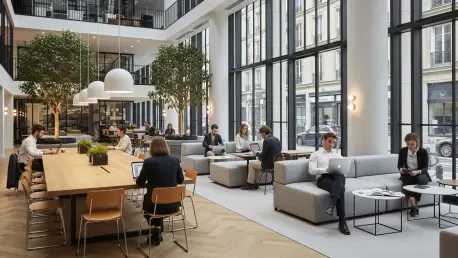
Beyond its physical structure, the hotel redefines the guest experience through the implementation of centralized social hubs. These areas are designed for co-working, dining, and community interaction, effectively blurring the lines between international travelers and local residents. By moving away from the isolated “tourist bubble” model, the project fosters a sense of place that resonates with a new generation of travelers. This integration ensures that the hotel provides value to the local economy and social fabric, rather than existing as a standalone entity.
Urban Integration: The Role of Mixed-Use Ecosystems
The hotel is strategically positioned within a larger site that includes 3.3 hectares of parkland and residential units. This surrounding infrastructure, including an expanded sports center and biodiversity shelters, creates a self-sustaining ecosystem that combats the urban heat island effect. Through an off-plan development agreement with Linkcity, the partners secured a role as an economic anchor for the district. This synergy between diverse land uses provides a built-in customer base and stabilizes the investment against market volatility.
Shaping the Future: Green Hospitality in Scarcity Markets
Paris remains a structurally constrained market where the scarcity of modern rooms creates a high barrier to entry for developers. Looking toward the 2026 to 2028 period, the success of this project suggests that future growth will be defined by ESG standards rather than sheer volume. Industry leaders expect an increase in “reversible” architectural designs and deeper integration with local energy grids as standard practice. Investment success will likely be measured by a property’s contribution to local biodiversity and social equity, reflecting a maturation of the global hospitality sector.
Strategic Insights: Navigating the New Development Landscape
For professionals in the real estate and hospitality sectors, the Python-Duvernois project provides several actionable takeaways. Prioritizing off-plan development agreements allows for greater oversight of sustainable features from the initial planning stages. Furthermore, focusing on mixed-use environments ensures that a property remains relevant to the local community, which is increasingly important for long-term viability. Future-proofing assets against tightening environmental regulations by seeking top-tier certifications early in the process is no longer optional but a baseline requirement for institutional investment.
A Blueprint for Sustainable Urban Growth
The partnership between Accor and EXTENDAM established a new precedent for how private equity and hospitality brands collaborated to solve complex urban challenges. By embedding a high-design lifestyle brand within a low-carbon, community-centric development, the project offered a clear path forward for the industry. This initiative proved that economic ambition and social responsibility were not mutually exclusive concepts. Ultimately, the development stood as a testament to the fact that the most successful hospitality assets were those that contributed meaningfully to their environmental and social surroundings.