
Katarina Railko is a distinguished authority in the hospitality and travel sectors, bringing a wealth of experience from the front lines of global tourism and large-scale event management. As an expert who has navigated the complexities of international expos and high-stakes hospitality, she offers a unique perspective on the intersection of visitor experiences and regional economic health. In this discussion, we explore the burgeoning cruise industry’s role as a powerhouse for global GDP, examining how the massive influx of passengers reshapes local job markets, fuels small-scale entrepreneurship, and creates a pipeline for long-term tourism through repeat visitations.
With cruise tourism contributing nearly $100 billion to the global GDP and double that in total economic output, how do these massive figures translate into daily financial stability for coastal regions? Could you break down the specific sectors that feel the strongest ripple effects from this heavy spending?
The $98.5 billion contribution to global GDP acts as a vital lifeline for coastal regions, turning seasonal arrivals into a consistent engine for financial stability. When we look at the $199 billion in total economic output, we see a ripple effect that touches everything from the fuel suppliers at the docks to the small cafes in the city center. The strongest impacts are felt in hospitality, transportation, and retail, where the daily influx of thousands of passengers creates a high-volume demand for immediate services. This steady flow of capital ensures that local governments can maintain infrastructure and that businesses can afford to pay out a portion of the $60.1 billion in global wages that the sector provides annually.
For every 20 cruise passengers, one full-time job is supported, fueling over 1.4 million onshore roles worldwide. How should local governments optimize their infrastructure to maximize this employment ratio, and what specific training programs are necessary to prepare residents for these diverse service and logistics roles?
To capitalize on the ratio of one job for every 20 passengers, local governments must prioritize “last-mile” infrastructure, such as efficient transit hubs and pedestrian-friendly walkways that lead directly into commercial districts. This connectivity ensures that the 1.4 million onshore roles in hospitality and local services remain viable and accessible to the local workforce. Training programs should focus heavily on skills development and cultural preservation, teaching residents how to manage high-capacity logistics while maintaining the unique charm of their home. By investing in specialized vocational training for tour operators and service staff, regions can ensure their residents are not just employees, but expert ambassadors for their local culture.
Direct spending from the cruise sector reaches approximately $93 billion, often flowing toward small enterprises and local artisans. What strategies should port destinations use to ensure these micro-economies are not sidelined by larger corporations, and how can they maintain authentic cultural offerings for these visitors?
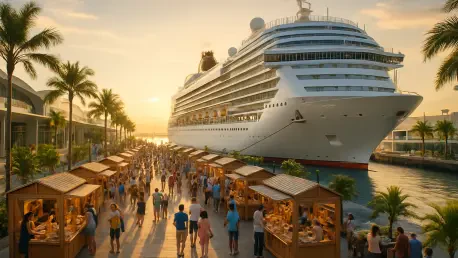
With $93 billion in direct cruise-related spending at stake, port destinations must actively implement “local-first” sourcing policies to protect their micro-economies from being overshadowed by global chains. One effective strategy is to create dedicated artisan zones near the ports where small enterprises and micro-businesses can showcase authentic crafts and culinary traditions without facing prohibitive real estate costs. This approach not only keeps the wealth within the community but also satisfies the modern traveler’s hunger for genuine, non-commercialized experiences. Maintaining this authenticity requires a partnership between cruise lines and local leaders to ensure that the “Cruising for Impact” pillars, specifically cultural preservation and community enrichment, are prioritized over mass-market retail.
More than 60% of cruise passengers return to destinations they first discovered via ship. How does this conversion from a cruise guest to a long-term visitor change the marketing strategy for a city, and what metrics determine if this repeat visitation is truly sustainable for the community?
The fact that over 60% of passengers return for a longer stay completely transforms a city’s marketing strategy from “one-off attraction” to “long-term relationship management.” Instead of focusing solely on the four-to-six-hour port window, marketers must highlight deeper experiences—like boutique hotels or immersive workshops—that entice guests to come back for a week-long land vacation. To measure sustainability, cities should track the “conversion rate” of cruise-to-stayover guests alongside the growth of local tax revenues from hotel stays. This shift ensures that the initial economic spark of the cruise ship evolves into a sustainable, year-round fire that supports the community long after the ship has left the harbor.
Since cruise capacity is expected to grow by 19% through 2028, what specific steps must leaders take to balance environmental innovation with rapid infrastructure development? How can they prevent overcrowding in popular ports while still increasing the total economic value provided to the region?
As we anticipate a 19% growth in capacity by 2028, leaders must integrate cruise tourism into their national development strategies with a focus on environmental innovation and health response. Managing overcrowding requires a sophisticated approach to scheduling and the development of “satellite” attractions to spread the visitor load across a wider geographic area, rather than concentrating it in a single port district. By investing in green pier technology and sustainable local transport, cities can absorb higher passenger volumes without degrading their natural resources. The goal is to maximize the economic value per passenger through high-quality, local-sourced experiences rather than simply chasing higher headcount.
What is your forecast for cruise tourism?
I forecast that cruise tourism will transition from being viewed as a self-contained vacation to becoming the world’s most powerful “destination incubator” for emerging markets. As passenger capacity grows, we will see the sector move beyond simple transit, with cruise lines and port cities co-investing in permanent infrastructure that benefits local residents as much as it does the travelers. We are entering an era where the success of a port will be measured not just by the $98.5 billion it adds to the GDP, but by the strength of its community partnerships and the diversity of the 1.8 million jobs it supports. Ultimately, the industry will become a leading force in global environmental and social innovation, proving that high-volume travel can be a catalyst for deep, localized prosperity.