
Embarking on an overnight train journey through Europe often conjures romantic images of efficiency and adventure, suggesting a savvy way to travel between cities while saving on accommodation and maximizing sightseeing time. For the budget-conscious traveler, the most economical seating-car option can appear as an unbeatable deal, a clever travel hack that promises to stretch a vacation budget further. However, the experience of a 12-hour trip from Berlin to Vienna aboard an OBB Nightjet puts this widely held belief to the test, offering a compelling case study on the true value of a bargain. This particular journey, secured with a mere $14 reservation, ultimately revealed a significant disparity between the advertised savings and the actual cost—a toll measured not just in dollars but in physical comfort and lost vacation time. The outcome serves as a critical examination of when a low price ceases to be a good deal and instead becomes a liability.
The Promise and the Price
The Allure of Efficiency and Economy
The decision to opt for an overnight train was fundamentally driven by a dual-pronged strategy of maximizing both time and financial resources for a European trip. The concept is powerfully simple: by traveling through the night, a traveler effectively gains a full day at their destination that would otherwise be consumed by transit. This approach also cleverly combines the cost of transportation and one night’s lodging into a single, significantly lower expense. In this instance, a pre-purchased seven-day Eurail pass brought the supplementary reservation fee for the 12-hour journey down to an astonishingly low $14, positioning it as the most economical accommodation of the entire trip. For any traveler meticulously managing a budget, this figure represents an almost irresistible opportunity to reallocate funds toward experiences, meals, or other travel priorities, making the overnight seating car seem not just a choice, but the most logical and practical one available for the route.
Previous travel experiences, particularly within the American Amtrak system featuring private sleeper cars, had inadvertently established a benchmark for comfort and privacy that profoundly shaped expectations for this European venture. That background, with its emphasis on personal space and dedicated sleeping arrangements, created a specific vision of what overnight rail travel entailed. The journey from Berlin to Vienna marked the traveler’s first encounter with a shared-space seating carriage, a common and highly economical option in Europe but a world away from a private roomette. This lack of familiarity with the budget-tier offering meant there was no prior context for the potential trade-offs. The anticipation was built on a foundation of relative luxury, setting the stage for a jarring confrontation with a much more spartan and communal reality—a reality for which past journeys had offered no preparation and which would redefine the understanding of what “overnight train” can mean.
A Stark Departure from Expectation
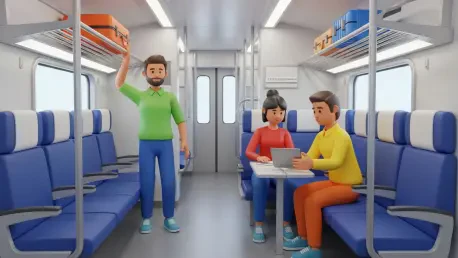
The divergence from expectations began the moment of boarding the OBB Nightjet at Berlin Ostbahnhof. The train’s interior presented an immediate and stark contrast to the anticipated comfort, with narrow, dimly illuminated corridors setting a confined and utilitarian tone. These hallways led to a series of small, enclosed cabins, each designed to accommodate six passengers. Upon entering the assigned cabin, where three other travelers were already present, the sense of confinement intensified. The space was palpably cramped, and it became clear that with a full complement of six passengers—two more would join within hours—personal space would be a nonexistent luxury. The only redeeming feature discovered in this initial assessment was the surprisingly generous amount of luggage storage available on racks positioned above the seats. This single positive observation, however, did little to mitigate the growing realization that the next 12 hours would be spent in close, unavoidable proximity to five complete strangers in an environment that prioritized capacity over comfort.
The design of the cabin and its seating arrangements proved to be the primary source of physical discomfort throughout the journey. The seats, while marginally wider than those found in a standard train coach, harbored a critical design flaw that made them fundamentally unsuitable for sleep. They were engineered to recline to a deep, almost-flat position, yet doing so created a pronounced and unyielding gap between the seatback and the bottom cushion. This structural issue made it impossible for a passenger to find a stable or comfortable resting position, negating the primary purpose of an overnight journey. Further compounding the lack of comfort, each seat was equipped with only a small, slide-out table from the armrest, providing a surface barely large enough for a smartphone and a ticket. Amenities were equally sparse; the entire six-person cabin was serviced by just two power outlets, a limitation that required passengers to coordinate and take turns charging their essential devices, adding a layer of logistical inconvenience to the pervasive physical discomfort of the ride.
A Closer Look at the Budget Experience
Bare-Bones Travel Amenities
The minimal nature of the budget ticket became increasingly evident through the stark lack of amenities typically associated with overnight travel. Comfort items such as pillows, blankets, or sheets were notably absent. An OBB Nightjet representative later clarified that such provisions are exclusively reserved for passengers in the more expensive couchette (bunk-style) and sleeper cars. The official recommendation, it turns out, is that the seating carriage is intended for shorter journeys, not for a full night’s rest—a critical piece of information not always apparent during the booking process. The ticket also did not include any complimentary meal or beverage service, though a menu was available offering a selection of snacks and light meals like pasta and wraps for purchase. The shared facilities further underscored the no-frills approach; the two bathrooms available in the car were described by the traveler as appearing unclean, creating a reluctance to use them. OBB’s official statement countered this observation, asserting that all toilets are thoroughly cleaned before every trip and are checked by staff during the night.
This experience highlights a crucial lesson in managing expectations for budget travel: the lowest price point often corresponds directly to the most basic level of service. The absence of simple comforts like a pillow can have a significant impact on the quality of an overnight journey, transforming what could be a restful trip into a grueling test of endurance. While the option to purchase food provides some level of convenience, it also represents an additional cost that begins to chip away at the initial savings. The state of shared facilities like bathrooms can be subjective, but it remains a key factor in overall travel comfort. For future travelers considering a similar option, it is essential to understand that a seating-car ticket on an overnight train is, in essence, just that: a ticket for a seat. It is a means of transportation from one point to another, not an accommodation designed for restorative sleep, and one should pack and plan accordingly for a long and potentially uncomfortable night.
The True Cost of the Ticket
The central failure of the journey was the complete inability to achieve any measure of sleep. This was not due to a single issue but rather a convergence of factors that created an environment fundamentally hostile to rest. The relentless physical discomfort was paramount; the constant bumps, sways, and vibrations of the train, magnified by the poorly designed seat with its awkward gap, made it impossible to settle. Beyond the physical, the social environment of the cramped cabin played a significant role. Being confined in such a small space with five other people, each shifting and moving throughout the night, created a subtle but persistent sense of unease that prevented true relaxation. Even after a fellow passenger mercifully turned off the main cabin light, the shared atmosphere remained disruptive. A strategic move to a less crowded cabin with only two other occupants backfired, as it introduced a new source of anxiety: the constant, low-level fear that a passenger with a valid reservation for the occupied seat could board at any of the numerous overnight stops, forcing a disruptive move in the middle of the night.
Upon arrival in Vienna at 7 a.m., the consequences of a completely sleepless 12-hour journey became painfully clear. The primary objective of the overnight train—to arrive rested and prepared to explore a new city—was entirely negated. The traveler was in a state of profound exhaustion, a condition that rendered immediate sightseeing impossible. The first and most urgent priority was not to visit a museum or a café but to find a hotel that would permit an early check-in for the sole purpose of sleeping. This unforeseen necessity led to the ultimate conclusion of the experience: the initial, impressive savings were a false economy. The money spent on securing a hotel room for several hours of daytime sleep effectively offset the savings from the cheap train ticket. The experience starkly demonstrated that the cheapest option is not always the best value, as the physical toll and the loss of a full day of exploration were not a worthwhile trade-off for the low price. The journey culminated in a decisive resolution for future travel: either opt for a flight or invest in a more expensive private cabin on an overnight train to guarantee a restful and productive start to a new day.