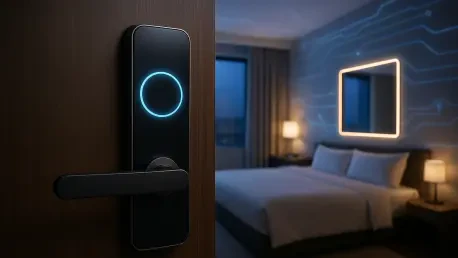

Implementing network segmentation is now a technical necessity to isolate guestroom IoT traffic from the critical business systems that store sensitive personal information. As the hospitality industry continues its rapid digital transformation, the seamless guest experience now depends on an invisible web of sensors, voice assistants, and automated services that operate around the clock. While these innovations provide an unprecedented level of convenience and personalization, they also introduce a massive, often unmanaged attack surface that traditional security measures are ill-equipped to handle. The transition to fully automated environments has meant that every smart lightbulb, motorized curtain, and biometric safe is a potential entry point for sophisticated cyber threats. In the current landscape of 2026, the physical security of a hotel room is no longer just about the strength of the door lock but about the integrity of the digital signals controlling it. As properties strive to stay competitive by layering more technology into their infrastructure, the complexity of securing these disparate systems has grown exponentially, leaving many operators in a vulnerable position where a single compromised device can lead to a brand-shattering data breach.
Fragmented Networks: The Vulnerability of Interconnected Guest Services
The current technological landscape in high-end hospitality is defined by a massive influx of Internet of Things (IoT) devices, many of which are manufactured by different vendors with varying security standards. This fragmentation creates a heterogenous environment where maintaining a uniform security posture is nearly impossible without rigorous oversight. Many of these smart devices run on proprietary software or lightweight operating systems that lack basic security features like robust encryption or the ability to run modern antivirus agents. Consequently, an attacker does not need to target a well-protected server directly; they can instead exploit a vulnerability in a poorly secured digital thermostat or a smart mirror in a guest suite. Once access is gained to one of these peripheral devices, the interconnected nature of the hotel’s internal network allows the intruder to move laterally. This lateral movement is the greatest risk to modern hotels, as it permits unauthorized users to jump from a low-security device in a single room to the property’s broader infrastructure, potentially compromising hundreds of other guest rooms or administrative systems in a single orchestrated campaign.
At the very center of this complex technological web lies the Property Management System (PMS), which serves as the operational heart of any modern hotel. The PMS is responsible for managing everything from room assignments and digital key distribution to payment processing and guest preferences. Because this system must communicate with almost every other smart device on the property—including Wi-Fi gateways, point-of-sale terminals in restaurants, and even elevators—it represents the highest-value target for malicious actors. A successful breach of the PMS provides a hacker with a comprehensive map of the hotel’s operations and access to the most sensitive data stored on-site, including credit card information, passport details, and historical travel patterns. The convergence of guest-facing amenities and core business functions into a single integrated network has turned the PMS into a single point of failure. If the security of a connected IoT device is compromised, it can serve as a bridge to this central repository, transforming a minor technical glitch into a catastrophic loss of privacy and financial data that can take years to recover from in terms of both legal liability and consumer trust.
Structural Challenges: Organizational Silos and Equipment Longevity
One of the most persistent obstacles to securing smart hotels is the traditional organizational structure of the hospitality industry, where technology management is often divided between disparate departments. In many organizations, the Information Technology (IT) team focuses on servers and corporate laptops, while the engineering or facilities department manages physical infrastructure like HVAC systems, lighting, and electronic locks. This division of labor frequently results in a “security vacuum” where IoT devices fall through the cracks because neither department feels fully responsible for their digital upkeep. When a smart HVAC system is installed, the engineering team may prioritize its functional performance over its network security, leading to default passwords and unpatched firmware remaining active for years. This lack of centralized oversight means that a hotel may have thousands of connected endpoints that are completely invisible to the primary security monitoring tools. Without a unified strategy that bridges the gap between physical facility management and digital security, the smart hotel remains a collection of vulnerable silos rather than a hardened, resilient enterprise.
Furthermore, a significant discrepancy exists between the physical durability of hotel hardware and the digital lifespan of the software that powers it. Hotel owners typically expect high-cost assets like electronic door locks, smart televisions, and automated mini-bars to remain in service for at least a decade to maximize their return on investment. However, the software and firmware supporting these devices often reach their end-of-life much sooner, sometimes within just three or four years of the product’s release. When a manufacturer stops providing security updates for a specific model of a smart lock or a room controller, that device becomes a permanent security hole that cannot be easily patched. This creates a scenario where a hotel is filled with “zombie technology”—hardware that functions perfectly for the guest but is fundamentally broken from a security perspective. As these devices age from 2026 to 2028, the risk only intensifies, as new vulnerabilities are discovered in legacy code while the vendors have long since moved on to newer products. Replacing thousands of locks or thermostats every few years is financially unfeasible for most properties, yet leaving them connected to the main network is a recipe for disaster.
Strategic Mitigation: Secure Procurement and Network Isolation
To effectively counter the rising tide of cybersecurity threats, hotel operators must fundamentally change how they approach technology procurement by prioritizing security over mere functionality. This proactive strategy involves vetting every potential supplier based on their commitment to long-term security support and their historical track record of responding to vulnerability disclosures. Contracts must now include specific clauses that mandate the delivery of security patches for the entire expected lifespan of the hardware, ensuring that the hotel is not left with unmanaged risks halfway through the asset’s use. By performing deep-dive security audits during the purchasing phase, management can identify products that use insecure communication protocols or lack necessary encryption standards before they are ever installed on the property. This shift from a convenience-first to a security-first procurement model is essential for building a foundation that can withstand the evolving tactics of modern hackers. It also ensures that the hotel is partnering with vendors who view cybersecurity as an ongoing partnership rather than a one-time transaction.
Beyond procurement, the technical architecture of the hotel network must be redesigned to follow the principle of least privilege through aggressive network segmentation. This involves creating isolated virtual networks for different categories of devices, ensuring that a smart television in a guest room has no technical path to communicate with the server that stores the hotel’s financial records. By compartmentalizing the network, an administrator can ensure that even if a specific IoT device is compromised, the impact of the breach is strictly contained within a small, non-critical segment of the infrastructure. This architectural approach prevents the lateral movement that hackers rely on to escalate their access within a system. Furthermore, implementing zero-trust security models—where no device is trusted by default, regardless of whether it is inside or outside the hotel’s perimeter—adds an additional layer of verification for every connection attempt. In an era where guest devices and hotel-owned IoT equipment are constantly entering and leaving the network, these rigorous isolation techniques are the only way to maintain a stable and secure environment without compromising the high-tech amenities that guests have come to expect.
Operational Resilience: Asset Visibility and Systematic Retirement
Maintaining continuous visibility into every connected asset is the final pillar of a robust cybersecurity strategy for the modern hospitality sector. It is impossible to protect what cannot be seen, and many hotel operators are surprised to discover hundreds of unauthorized or forgotten devices connected to their guest Wi-Fi or back-of-house networks. Implementing automated asset discovery tools allows security teams to maintain a real-time inventory of every endpoint, including its manufacturer, current firmware version, and communication behavior. By establishing a baseline of “normal” activity for each device class, such as a smart thermostat only communicating with its dedicated controller, the system can immediately flag unusual data transfers that might indicate a breach. Active monitoring and centralized logging provide the forensic data necessary to identify the source of an intrusion quickly, potentially stopping an attack in its tracks before sensitive data is exfiltrated. This level of operational awareness transforms the hotel’s defense from a passive shell into an active, responsive system capable of identifying and neutralizing threats as they emerge in real-time.
The final phase of this lifecycle approach involved the systematic retirement and decommissioning of technology that could no longer meet modern security standards. When devices reached their end-of-life or ceased to receive critical updates, management teams proactively decided to either replace the hardware entirely or disconnect its smart features to eliminate the risk. For legacy equipment that remained essential for operations but lacked modern defenses, engineers implemented secondary layers of isolation, such as dedicated hardware firewalls or physical network gaps, to ensure they could not be used as entry points. By treating the retirement of old tech as a core business priority, leaders maintained the integrity of their digital infrastructure and protected the privacy of their guests. This shift toward a holistic lifecycle management strategy ensured that cybersecurity was no longer viewed as a one-time IT project, but as a continuous operational discipline that evolved alongside the technology itself. As the industry looked toward the future, the successful hotels were those that recognized the value of their digital reputation and invested the necessary resources to secure it against an increasingly complex threat landscape.