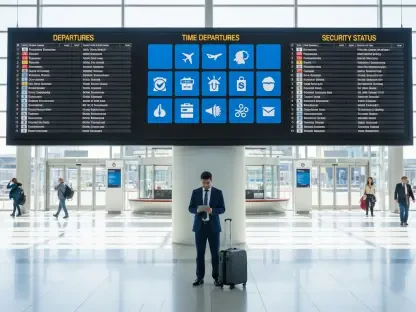
With Sydney Airport bracing for an unprecedented holiday surge of over 5.84 million passengers, the logistics of managing this massive influx become a critical focus. The anticipated 3% rise in travelers between mid-December and late January isn’t just a number; it represents a monumental challenge for airlines, airport staff, and the city’s hospitality sector. To unpack what this means on the ground, we spoke with Katarina Railko, a leading expert in the travel and tourism industry. In our conversation, we explored the intricate operational strategies airlines are deploying to handle the rush, the technological upgrades designed to streamline the passenger journey, and the distinct challenges posed by the surge in both international and domestic travel.
The airport is forecasting a 3% passenger increase to 5.84 million travelers this holiday season. Looking beyond just adding more flights, can you walk us through the detailed operational adjustments that major airlines like Qantas and Emirates are making to manage such a significant surge in demand?
Of course. What people often don’t see is the incredible logistical ballet happening on the tarmac and behind the scenes. For airlines, it’s about maximizing asset utilization. Qantas, for instance, isn’t just adding flights; they’re strategically deploying their upgraded, larger aircraft on the most popular routes to increase capacity per flight. Emirates is doing something similar by leaning heavily on its A380 fleet for the Sydney connection. This is a game of inches and minutes. The key metrics they live and die by are turnaround times—how quickly they can deplane, clean, refuel, cater, and board a full aircraft—and on-time performance. A delay on one flight can have a cascading effect across the entire network, especially during a peak season like this. It’s a high-pressure environment where ground crews, pilots, and cabin staff are all synchronized to shave precious minutes off each cycle to keep the whole system flowing.
International traffic at the T1 terminal is projected to jump by 6.5%, with a notable influx from places like New Zealand and the UAE. What kind of specific infrastructure upgrades and passenger flow strategies are being rolled out to absorb this, and could you give us an example of how a peak arrival wave is managed?
This is where the airport’s recent investments truly come into play. The focus is on eliminating bottlenecks throughout the passenger journey, from the moment they step off the plane. Let’s imagine a peak arrival wave, say two or three wide-body jets landing within minutes of each other. The first step is orchestrating gate allocation so that passengers aren’t held on the tarmac. As they enter the terminal, the goal is to get them to immigration as smoothly as possible. This is where expanded immigration areas and the new SmartGate kiosks are critical. Staff on the floor act as traffic controllers, actively directing travelers with eligible passports toward the faster self-processing kiosks, which immediately splits the crowd and reduces pressure on the manual booths. Simultaneously, the upgraded baggage handling systems are working overtime to get luggage onto the carousels faster. A long wait for bags is a major point of congestion, so ensuring that system is efficient is paramount to clearing the arrivals hall and making space for the next wave.
On the busiest days, like December 12, passengers are being advised to arrive up to three hours early for international flights. When passenger volumes hit these record highs, what specific protocols are activated behind the scenes, especially concerning security staffing and managing the inevitable vehicle congestion at drop-off zones?
When the airport anticipates a peak day with over 65,000 international travelers, it triggers what we call a ‘surge protocol.’ It’s not just business as usual with longer lines. Extra security lanes, which might be closed during normal operations, are opened well in advance, and staffing schedules are overlapped to ensure maximum manpower during the crunch. It’s a proactive measure, not a reactive one. On the landside, managing vehicle traffic is one of the biggest challenges. You’ll see a much more visible presence of traffic marshals on the forecourt. The plan to redirect some drop-off traffic to the arrivals level is a clever tactic. It effectively creates a second drop-off zone, doubling the capacity of the kerb and preventing the departures area from becoming completely gridlocked, which would otherwise bring airport access to a standstill. It’s all about creating redundancy and alternative flows to keep things moving.
With 3.14 million domestic travelers expected through the T2 and T3 terminals, the scale is immense. How does the operational strategy for these terminals differ from the international focus at T1, particularly when coordinating with carriers like Virgin Australia on high-frequency routes?
The operational mindset for domestic travel is fundamentally different. While T1 is about managing complexity—passports, visas, customs—T2 and T3 are all about speed and frequency. The rhythm is much faster. For high-frequency routes like Sydney to Melbourne or Brisbane, which are some of the busiest in the world, the goal is a rapid, seamless turnaround. The coordination with airlines like Virgin Australia is constant and data-driven, focusing on ensuring gate availability aligns perfectly with their packed schedules. It’s less about the long dwell time you see with international passengers and more about processing a high volume of travelers quickly. The advice for passengers reflects this: arrive one or two hours early, not three. The entire infrastructure, from check-in to security and boarding, is designed for a commuter-like efficiency to handle that constant churn of flights departing every few minutes.
The article highlights new SmartGate kiosks and security lanes as key tools for managing this holiday rush. Could you elaborate on how this technology translates into tangible improvements in passenger throughput and what kind of targets are set for reducing wait times during this period?
This technology is a genuine game-changer. The SmartGate kiosks are a perfect example of a force multiplier. By allowing a large portion of travelers to self-process through immigration, you’re not just speeding them up; you’re freeing up highly trained Border Force officers to focus on more complex cases or passengers who require manual checks. This dramatically increases the overall throughput per hour for the entire immigration hall. For security, the new lanes are about more than just a new coat of paint. They often incorporate automated tray return systems and more advanced scanning technology, which reduces the amount of manual handling and secondary screening needed. Every second saved per passenger—not having to wait for a tray, or having your laptop scanned in the bag—accumulates into massive time savings when you’re processing tens of thousands of people. While specific targets are internal, the ultimate goal is to keep the maximum queue time below a certain threshold, even during the absolute peak, ensuring the passenger experience doesn’t degrade into chaos.
What is your forecast for the future of airport management during peak travel seasons?
Looking ahead, I believe the future is about moving from reactive crowd management to proactive, personalized journey management. We will see an even deeper integration of AI and biometric technology. Imagine an airport system that uses predictive analytics, factoring in road traffic and flight schedules, to send a notification to your phone suggesting the precise time you should leave for the airport to avoid queues. Your face could become your boarding pass, allowing you to walk seamlessly from the kerb to the gate without ever pulling out a document. The goal is to make these record-breaking travel periods feel less like a stressful ordeal and more like the start of a fantastic holiday, by using technology to make the entire process smoother, faster, and more intuitive for every single traveler.