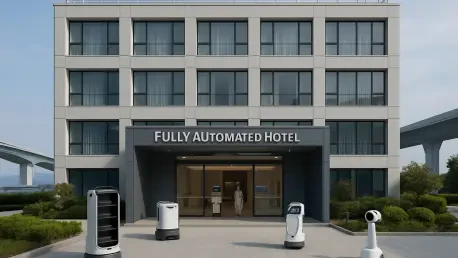

The rapid transformation of global travel infrastructure has reached a new milestone as Pudu Robotics prepares to unveil the world’s first fully automated hotel on West Artificial Island. Situated along the strategically significant Shenzhen-Zhongshan Link, this 44-room property is designed to serve as more than just a place for weary travelers to rest; it functions as a live laboratory for the future of service. By the time it reaches full operational capacity in 2027, the facility will have replaced almost every traditional human-facing role with a sophisticated network of artificial intelligence and physical machines. This project represents a bold departure from the incremental adoption of technology seen in traditional lodging, aiming instead for a comprehensive integration that treats automation as the backbone of the guest experience. The initiative highlights a shift in how the industry perceives labor, moving from human-centric toward a paradigm where precision and reliability are the primary drivers of satisfaction.
Transitioning to Holistic Automation
From Task-Specific Bots to Unified Ecosystems
The evolution of hospitality technology has long been characterized by the isolated deployment of machines designed for very specific, narrow tasks like vacuuming carpets or delivering room service orders. However, the West Artificial Island project signifies a move toward a “full-scenario” model where the entire guest journey is managed by a coordinated robotic fleet. In this environment, the technology is not an auxiliary support system but the primary operational force that handles everything from front-desk reception to back-of-house logistics. This holistic approach eliminates the fragmented nature of traditional automation, ensuring that every touchpoint—from the moment a guest arrives at the terminal to the final checkout—is synchronized. By centralizing these functions, the property reduces the friction often caused by human communication errors or staffing gaps. The result is a seamless transition between services, where logistics and guest interactions are governed by a single, unified operational logic.
Orchestrating Intelligence Through PuduFM 1.0
At the core of this ambitious operational model lies a sophisticated AI architecture known as PuduFM 1.0, which represents a significant leap in “embodied AI” technology. This framework allows the robotic staff to perceive and navigate complex physical environments with a degree of spatial awareness that was previously impossible for standard service bots. Orchestrated by a software platform called PuduAgent, these machines operate as a synchronized team rather than a collection of independent units. This connectivity ensures that different types of robots can communicate with one another, sharing real-time data about elevator traffic, guest locations, and maintenance priorities. By avoiding interference during peak operational hours, the system maintains a steady flow of service that mimics the intuition of a well-trained human crew. The integration of such a high-level software layer is what transforms a group of machines into a responsive ecosystem capable of adapting to the unpredictable nature of daily hotel operations.
The Technological and Cultural Foundation
Specialized Fleets and Regional Advantages
To address the varied requirements of a full-service hotel, Pudu Robotics has developed a specialized fleet of machines tailored to specific functional niches. For example, the PUDU T300 is a heavy-duty logistics unit designed to navigate corridors with luggage and housekeeping supplies, while the BellaBot Pro serves as the primary face of guest interaction. The BellaBot Pro is equipped with advanced social cues and the ability to facilitate food delivery with a friendly, interactive demeanor. This diversity ensures that specialized tasks, such as floor cleaning and retail support, are performed with a level of precision that general-purpose machines simply cannot replicate. By matching specific robotic hardware to specialized hotel functions, the developers have ensured that the quality of service remains high across all departments. This strategy also allows for the continuous refinement of individual machine types without disrupting the broader network, providing a scalable model for future properties that may require different service configurations.
Urban Readiness and the Shenzhen Experiment
Shenzhen serves as the ideal location for this grand experiment due to its position as a global epicenter for robotics manufacturing and its high degree of local technological acceptance. Consumers in this region are already deeply accustomed to app-based services and autonomous delivery systems, making them far more likely to embrace a robotic hotel as a convenient upgrade rather than a confusing or intimidating novelty. This cultural readiness provides a critical testbed for determining whether fully automated service models can thrive in high-density urban environments. The project benefits from proximity to a dense supply chain, allowing for rapid iteration and technical support that would be difficult to achieve in less developed regions. Furthermore, the local government’s support for smart city initiatives has created a regulatory environment that encourages such bold ventures. This combination of infrastructure, consumer behavior, and policy makes the West Artificial Island property a pivotal case study for the global expansion of autonomous hospitality.
Evaluating the Future of Service
Balancing Efficiency With the Human Touch
Despite the remarkable technological capabilities demonstrated by the automated fleet, the project continues to raise fundamental questions about the role of human empathy in high-end service. While robots are undeniably superior at performing repetitive, labor-intensive tasks with consistent quality, they currently lack the emotional intelligence needed for nuanced service recovery or the handling of complex guest grievances. This makes the robotic hotel a vital testing ground for identifying which aspects of the hospitality experience are best served by algorithms and which still necessitate the presence of a person. Finding the right balance is essential for maintaining the prestige associated with professional lodging. The industry is watching closely to see if digital interactions can eventually provide the same sense of warmth and belonging that traditional staff offer. If the technology can handle the “dull and dangerous” aspects of the job, it may ultimately free humans to focus exclusively on creating deep, meaningful connections with travelers.
Strategic Pathways for the Global Industry
The West Artificial Island initiative established a concrete precedent for how the hospitality sector addressed the persistent challenge of labor scarcity in high-traffic urban centers. By proving that a unified AI platform could manage complex logistics and maintenance without human intervention, the project offered a clear blueprint for regional developers to follow. Stakeholders recognized that the success of such models depended heavily on the early integration of robotic infrastructure during the architectural design phase rather than as an afterthought. Future implementers prioritized investments in interoperable software platforms that allowed diverse hardware fleets to communicate across a shared network. This shift ultimately empowered human staff to transition toward roles that required high-level problem solving and personal connection, effectively reclassifying hospitality as a field defined by emotional depth rather than routine maintenance. Industry leaders adopted these findings to ensure long-term operational resilience and to create more predictable experiences for travelers.