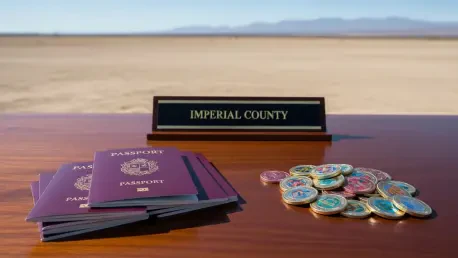

Standing amidst the parched, sun-baked landscape of California’s Imperial County, one might expect to find only scrub brush and heat waves, yet this desolate stretch of desert serves as the sovereign soil of a self-proclaimed republic. The Republic of Slowjamastan represents a fascinating intersection of performance art, geopolitical satire, and a personal project that has evolved into a global phenomenon. What began as a radio personality’s frustration with pandemic-related travel restrictions has blossomed into a conceptual nation that challenges traditional definitions of sovereignty while providing a lighthearted escape from the divisiveness of modern society. Randy Williams, a San Diego-based radio professional known as “R Dub,” was on a mission to visit every country recognized by the United Nations when the world ground to a halt. By early 2020, he had only one country left on his list, but with borders closed, he decided that if he could not visit the last nation, he would simply build his own. In 2021, he purchased 11 acres of land along State Route 78, laying the foundation for a project that would eventually capture the imagination of thousands of people across the globe.
Establishing a Desert Identity
The Birth of a Sultanate: From Satire to Sovereignty
The transformation of a dusty plot of land into a budding micronation began as an escalating creative exercise between Randy Williams and his close associates. Initially, the project was met with a degree of skepticism by his peers, who viewed the endeavor as a momentary distraction or a joke that would eventually run its course. However, Williams leaned into the absurdity, adopting the persona of the “Sultan of Slowjamastan” to lend the project a sense of theatrical gravitas. Clad in a military-style uniform adorned with elaborate epaulettes and dark sunglasses, he modeled his appearance after historical figures of authority, creating a character that was both a parody and a tribute to the aesthetics of mid-century statecraft. This persona was not merely visual; it included a carefully crafted “General Foreign Accent” designed to be intentionally ambiguous, further detaching the micronation from any specific existing culture while heightening the sense of playful escapism.
This commitment to the character of the Sultan allowed Williams to treat the 11 acres of desert scrub as a blank canvas for a new kind of experimental society. By 2026, the initial vision had expanded far beyond the early days of simply placing a desk in the middle of the wilderness. The Sultanate became a vehicle for creative expression, allowing the founder to engage in the sort of world-building typically reserved for novelists or game designers. The project resonated because it tapped into a universal desire to reclaim a sense of agency in a world that often feels overly regulated and complex. By assuming the role of a benevolent dictator, Williams created a framework where the only limit was the reach of his own imagination, successfully turning a remote corner of the California desert into a stage where the boundaries between reality and performance are intentionally blurred for the amusement of a growing international audience.
National Symbols and Quirky Laws: Defining the Cultural Boundaries
To truly distinguish Slowjamastan from the surrounding American territory, Williams established a set of unconventional laws and symbols that prioritize humor and collective levity over traditional governance. The national identity is anchored by a constitution that explicitly forbids common modern nuisances, such as the practice of “replying-all” to mass emails when a private response would suffice. In a similarly whimsical vein, the wearing of Crocs is strictly prohibited within the borders, a law that serves as a playful litmus test for the nation’s cultural sensibilities. These mandates are not intended to be oppressive but rather to act as a shared joke that bonds the community together through a mutual appreciation for the ridiculous. The national anthem, a clever parody of a popular classic rock song, provides a musical backdrop to flag-raising ceremonies that occur with surprising frequency, reinforcing the idea that even a desert plot can have a soul.
Beyond the legal code, the symbols of the nation are chosen to evoke a sense of quirky pride among those who claim citizenship. The raccoon was designated as the national animal, representing a scrappy and adaptable spirit that mirrors the nation’s own origins. While traditional states might choose majestic eagles or lions, the choice of a common North American scavenger underscores the self-deprecating nature of the project. Furthermore, the official policy on speeding—which is technically permitted only if the driver is in a legitimate rush to get home with fresh tacos—highlights the regional flavors and priorities of the “citizens” who inhabit the nearby areas. These cultural touchstones serve a critical purpose: they transform the land from a mere real estate investment into a shared conceptual space where participants can check their serious political affiliations at the door and engage in a collective act of creative whimsy.
Statecraft and National Infrastructure
The Trappings of Sovereignty: Building the Illusion of a State
While Slowjamastan may be a micronation born of satire, its physical infrastructure has grown to include many of the tangible markers associated with a legitimate sovereign state. Williams has invested significant personal resources into acquiring and branding various national assets to enhance the immersive experience of visiting the republic. Travelers passing by the property on State Route 78 are greeted by a formal border checkpoint and an immigration booth, which serve as the primary points of contact for “foreigners” entering the Sultan’s domain. These structures are more than just props; they are essential components of the performance, forcing visitors to pause and acknowledge the transition from the United States into a space with its own set of rules. The presence of police cars, fire trucks, and emergency medical equipment, all bearing the official Slowjamastan crest, further solidifies the illusion of a functioning, self-sufficient society.
The dedication to these “trappings of sovereignty” extends to the creation of a unique bureaucratic system that issues official documentation to its citizens. The Republic of Slowjamastan mints its own currency and issues high-quality passports that, while not recognized by international customs agencies, hold immense value within the community as symbols of membership. These items are produced with a level of detail that rivals genuine government documents, featuring intricate watermarks and security features that reflect the founder’s background in design and his commitment to the bit. By surrounding himself and his guests with these physical manifestations of statehood, Williams bridges the gap between a purely digital community and a physical reality. The infrastructure acts as a anchor for the imagination, providing a tangible foundation upon which the elaborate narrative of the micronation can continue to flourish and expand in the coming years.
Landmarks and Territorial Organization: Mapping the Desert Dream
The 11-acre territory of Slowjamastan is meticulously divided into several “states,” each possessing its own unique character and whimsical nomenclature. Names like Dublândia, Bucksylvania, and the Queendom of Hotdamnastan serve to organize the scrubland into a manageable geography, allowing the Sultan to appoint honorary governors and local officials. This territorial organization adds a layer of complexity to the micronation, transforming a single plot of land into a diverse “union” of regional identities. One of the most iconic landmarks within these borders is the SS Badassin, a derelict, land-locked submarine that has been humorously repurposed as the nation’s primary naval defense. The presence of a submarine in the middle of a dry desert is the ultimate visual gag, summarizing the spirit of a nation that refuses to be constrained by geographical or logical limitations.
Future growth is a constant theme in the development of the land, as evidenced by the prominent signage for the “Randy Williams International Airport,” which is noted as “coming soon(ish).” This aspirational landmark serves as a reminder that the project is ongoing and that the conceptual borders of the nation are always expanding. The Sultan has also designated specific areas for public gatherings and diplomatic events, ensuring that the physical site can accommodate the influx of curious tourists and dedicated citizens who make the pilgrimage to the desert. This focus on landmarks and mapping is a crucial part of the state-building process; it gives the citizens a sense of place and a feeling of belonging to something larger than themselves. As more structures are added and the “states” become more defined, the Republic of Slowjamastan continues to evolve from a simple desert clearing into a complex, multi-layered environment that rewards exploration and participation.
Global Impact and the Micronation Movement
A Growing Population of Digital Citizens: The Appeal of Neutral Ground
Despite its remote location and relatively small physical footprint, the Republic of Slowjamastan has managed to amass a population of over 25,000 self-registered citizens from more than 120 different countries. This staggering number places the micronation’s “population” well above several United Nations-recognized states, such as Tuvalu or Vatican City. The primary driver of this growth is the nation’s digital presence and its positioning as a “great escape” from the realities of modern geopolitics. In an era marked by intense political polarization and social unrest, Slowjamastan offers a neutral sanctuary where outside politics are strictly forbidden. This policy creates a unique social environment where individuals from vastly different backgrounds can interact without the baggage of their home countries’ conflicts, united instead by a shared sense of humor and a love for the absurd.
The process of obtaining citizenship is designed to be accessible and engaging, requiring only a simple online registration that appeals to the internet-savvy demographic. For many, becoming a citizen of Slowjamastan is a way to participate in a global community that values levity and creativity over rigid ideology. While the basic citizenship is free, the Sultanate also offers opportunities for individuals to enhance their status through the purchase of honorary titles, such as Ambassador or Member of Parliament. These roles provide a sense of prestige and a conversation starter for those looking to add a bit of flair to their professional or personal profiles. The surge in applications from countries as diverse as Bangladesh and Uzbekistan demonstrates the universal appeal of the micronation’s message. It suggests that people everywhere are looking for a place where they can belong to something meaningful without the heavy burdens associated with traditional national identities.
Connection to the Global Micronation Movement: Networking for New States
Slowjamastan does not exist in a vacuum; it is part of a vibrant and diverse global movement of micronations—entities that claim sovereignty but lack formal recognition from established world governments. This movement includes famous examples like the Principality of Sealand, located on a former military platform in the North Sea, and the Republic of Molossia in the Nevada desert. These nations often collaborate and recognize one another, creating a parallel diplomatic world that mirrors the structures of the United Nations. Slowjamastan has quickly become a leader in this community, leveraging the Sultan’s media savvy and the nation’s rapid growth to build bridges with other “heads of state.” This networking is essential for the long-term viability of the project, as it provides a sense of legitimacy within the specific context of the micronation subculture and allows for the exchange of ideas on governance and community building.
The culmination of these diplomatic efforts is evidenced by the republic’s role in organizing major international gatherings. In 2027, Slowjamastan is scheduled to host MicroCon, a premier event that brings together delegates from dozens of micronations to discuss everything from heraldry and coat-of-arms design to the philosophical implications of sovereignty. This gathering, often described as a mix of high-level statecraft and enthusiast cosplay, allows participants to validate each other’s projects and share strategies for engaging their respective citizenries. For Randy Williams, hosting such an event in a San Diego skyscraper represents a significant milestone in the development of his nation. It moves the project beyond the 11 acres of desert and into the broader cultural conversation, proving that while Slowjamastan may be unrecognized by the UN, it is a very real and influential force within the global community of dreamers and nation-builders.
Future Perspectives on Creative Sovereignty
The evolution of Slowjamastan demonstrated that the traditional concepts of nationhood were surprisingly flexible when challenged by creative expression and digital community building. By the time the founder achieved his lifelong goal of visiting every recognized country on Earth, his own creation had already become a permanent fixture in the lives of thousands of people. The project succeeded because it offered a tangible solution to the problem of social fragmentation, providing a shared narrative that prioritized joy over conflict. What began as a response to restricted travel became a testament to the idea that a community can be defined by its sense of humor just as effectively as by its borders. The “faux dictatorship” managed to foster a more inclusive and welcoming environment than many genuine democracies by simply refusing to take itself too seriously.
Moving forward, the success of this micronation suggested that there was a significant appetite for spaces that allow for playful statecraft and the rejection of standard political norms. For those interested in building their own communities or unconventional projects, the key takeaway was the importance of consistent branding and a strong, lighthearted narrative. Slowjamastan proved that people were willing to invest their time and identity into a concept if it provided them with a sense of belonging and a respite from the daily grind. As the world continued to grapple with complex geopolitical challenges, these small pockets of intentional absurdity provided a necessary vent for collective stress. The future of such movements likely involves even greater digital integration and the continued blurring of lines between physical reality and shared conceptual spaces, ensuring that the spirit of the desert republic will endure.