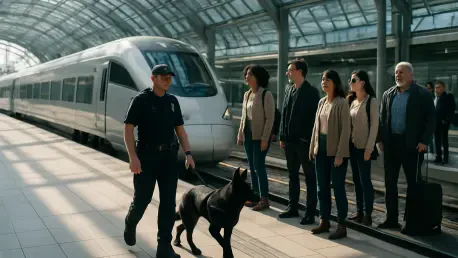

Immediately following the attacks on September 11, Amtrak executed an unprecedented nationwide service suspension to perform exhaustive security sweeps of every track, bridge, and tunnel. This decisive action underscored a permanent shift in how the United States viewed its passenger rail network, transitioning it from a mere utility of convenience to a critical asset of national security. While the aviation industry underwent a visible and structural overhaul, the transformation of rail was equally profound yet arguably more complex due to the open-access nature of train stations. For decades, the national rail carrier had prioritized seamless travel, but the events of 2001 necessitated a rigorous reconciliation between mobility and protection. This evolution required the integration of advanced surveillance, specialized policing, and a cultural shift among both staff and passengers. Consequently, the national rail provider began a long-term journey to harden its infrastructure while maintaining the fluidity that makes rail travel essential for millions.
Professionalization of Law Enforcement and Intelligence
The Amtrak Police Department has undergone a massive structural shift, moving from a standard patrol-based force to a sophisticated, intelligence-led organization. In the years following the 2001 tragedy, the department realized that a reactive posture was insufficient for a modern threat landscape. By establishing a dedicated Intelligence Unit, officials began to synthesize global threat data and domestic security trends to inform daily operations. This data-driven approach allows commanders to deploy resources more effectively, targeting specific high-traffic corridors and major transit hubs like Penn Station or Union Station based on real-time risk assessments. Instead of simply maintaining a presence, officers are now trained in behavioral detection and advanced investigative techniques. This proactive philosophy ensures that security measures are not static but are constantly evolving to meet the specific challenges posed by both physical and digital threats to the national rail system.
Furthermore, the integration of multi-agency collaboration has created a “defense-in-depth” strategy that was non-existent in the previous era. Amtrak frequently participates in the Multi-Agency Super Surge, an initiative that involves a high-visibility saturation of transit environments by federal, state, and local law enforcement. These operations serve as a powerful deterrent and include the use of explosive detection canine units, which are now a permanent fixture of the rail security landscape. Random baggage screenings and visual inspections of platforms have become standard protocols, mimicking some aspects of aviation security without the bottlenecks of fixed checkpoints. This layered approach ensures that if one security measure fails, several others remain in place to mitigate the risk. The goal is to create an environment that is perceived as a “hard target” by potential adversaries while remaining welcoming and efficient for the thousands of daily commuters who rely on the service.
Decentralizing Vigilance Through Human Assets
The organizational philosophy shifted toward the realization that technology alone cannot secure a vast, sprawling network of tracks and stations. Amtrak prioritized the human element by launching comprehensive security awareness programs for its entire workforce. From conductors and engineers to maintenance crews and ticket agents, every employee was designated as a critical link in the security chain. These frontline workers are trained to identify subtle anomalies that might escape the notice of a general patrol officer, such as an unattended bag in a restricted area or an individual displaying suspicious behavioral cues. By decentralizing the responsibility for surveillance, the organization effectively turned thousands of employees into specialized observers. This internal vigilance ensures that monitoring happens at the ground level, covering the vast stretches of track and remote infrastructure that are difficult to monitor solely through electronic means or fixed cameras.
Simultaneously, the relationship with the traveling public was redefined to foster a culture of shared responsibility and community ownership. Public awareness campaigns, most notably the “See Something, Say Something” initiative, encouraged passengers to become active participants in their own safety. By providing clear channels for reporting concerns, such as dedicated text lines and smartphone applications, the organization bridged the gap between the public and law enforcement. This strategy was not merely about gathering information but about creating an environment where security was normalized as part of the travel experience. The success of this approach relied on transparency and trust, ensuring that passengers felt empowered rather than intimidated. As a result, the national rail network achieved a unique balance where high-level security was integrated into the daily routine of commuting, allowing the system to remain open and accessible while maintaining a high level of alert.
Adapting to Modern Threats and Infrastructure Resilience
The scope of security concerns expanded significantly as digital threats and physical vulnerabilities became more intertwined in the modern landscape. Amtrak responded by significantly increasing its investment in cybersecurity to protect the critical systems that govern train signaling, dispatching, and ticketing operations. As the rail network became more automated and connected, the potential for a cyber-related disruption grew, prompting the creation of a specialized department focused on protecting the integrity of its data networks. This digital fortification was paired with physical upgrades to aging infrastructure, particularly along the Northeast Corridor, where tunnels and bridges are most vulnerable to both intentional harm and the effects of extreme weather. The definition of security was thus broadened to include general resilience, ensuring that the rail system could withstand and rapidly recover from a wide variety of systemic shocks, whether they were man-made or natural.
The transformation achieved by the organization established a blueprint for how a public utility could maintain its primary mission while operating under heightened security. Looking back at the progress made since 2001, it was clear that the integration of intelligence, employee training, and public cooperation created a robust framework for national stability. Stakeholders recognized that security was not a final destination but a continuous process that required constant investment and adaptation. The lessons learned during this quarter-century focused on the necessity of flexibility, where static defenses were replaced by dynamic, risk-based strategies. Moving forward, the focus remained on the deployment of non-intrusive scanning technologies and the further hardening of digital assets against emerging cyber threats. This history of evolution proved that the safety of the national rail network was best secured through a holistic approach that combined advanced technology with the vigilance of a dedicated community.