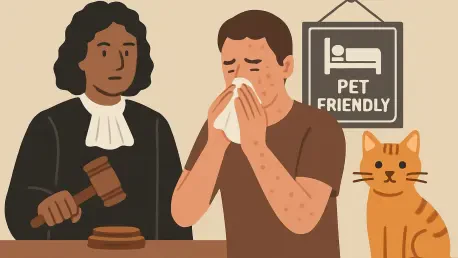

The intersection of medical necessity and business protocol is tested when a guest claims an emergency after refusing an initial offer to leave without charge. In the hospitality landscape of 2026, the surge in pet-inclusive travel has fundamentally altered how properties manage their inventory and guest relations. While pet-friendly policies are a lucrative draw for a massive demographic of animal owners, they present a significant challenge for individuals with severe environmental sensitivities. When these two worlds collide, the resulting conflict often centers on the boundary between a hotel’s duty of care and the personal responsibility of the traveler. Modern establishments go to great lengths to provide digital disclosures and physical warnings, yet some patrons still choose to book environments that are fundamentally incompatible with their health requirements. This dynamic creates a complex web of liability where transparency from the staff must be met with informed decision-making from the guest to avoid medical crises and financial disputes.
Establishing Responsibility and Professional Transparency
The Role: Guest Due Diligence
Travelers in the current year are equipped with more information than ever before, utilizing sophisticated booking filters that can isolate properties based on hyper-specific health and safety criteria. When an individual suffers from a life-threatening or severe allergy to animal dander, the burden of selecting a compatible environment rests primarily on their shoulders during the planning phase. By 2026, every major travel aggregator clearly tags pet-friendly properties, making it almost impossible to book such a location by accident. Choosing to ignore these labels or assuming that an older building can provide a sterile, dander-free sanctuary is a significant lapse in judgment that compromises the safety of the guest. The act of finalizing a reservation at a known pet-friendly hotel constitutes a tacit acceptance of the environmental risks inherent in a space where animals are regularly permitted to reside and move through common areas.
Furthermore, the responsibility of the guest extends to the check-in process, where a final opportunity for transparency usually occurs. If a traveler is aware of their medical limitations, they have a professional obligation to verify the property’s capabilities with the on-site staff before accepting a room key. Failing to disclose a severe medical condition while simultaneously ignoring the physical signs of a pet-friendly environment creates a scenario where the guest is effectively gambling with their own well-being. In the hospitality industry, a guest’s failure to perform basic research or heed clear warnings is increasingly viewed as an assumption of risk. When a consumer proceeds with a transaction despite being fully informed of the potential hazards, they essentially release the service provider from liability regarding the specific condition they chose to disregard, provided the hotel has been honest about its facilities.
Disclosure: A Liability Shield
Hotels effectively mitigate their legal and financial exposure by maintaining a policy of absolute transparency regarding the limitations of their physical infrastructure. When a front desk employee explicitly informs a guest that the building is older and does not offer designated pet-free rooms, they are providing the guest with the critical information needed to make a safe choice. In professional hospitality management, offering an immediate, penalty-free cancellation is considered the gold standard of ethical service when a guest’s medical needs cannot be met. This proactive approach shifts the legal burden away from the establishment and places it squarely on the patron. If the hotel offers a full refund and an exit strategy before the room is even touched, and the guest chooses to stay anyway, the hotel has fulfilled its primary duty of care by preventing the situation from escalating.
The documentation of these interactions serves as a vital safeguard for the business against future claims of negligence or medical malpractice. By 2026, most properties have implemented digital logs or recorded interactions that capture the moment a guest was warned about allergen levels and subsequently chose to proceed. This transparency ensures that if a medical emergency later occurs, the hotel can demonstrate that they did not misrepresent their facilities or coerce the guest into staying. Professional staff training now emphasizes the importance of these early interventions, as they are the most effective way to prevent both health crises and the administrative headache of disputed charges. Ultimately, a hotel cannot be expected to provide a specialized medical environment that it does not possess, and honest communication is the only tool available to ensure that sensitive travelers find accommodations that are truly safe for them.
Navigating Financial and Operational Conflicts
The Impact: Room Occupancy
Once a guest accepts a room key and occupies a space for a significant duration, the operational costs for the hotel begin to accrue regardless of whether the guest stays for ten minutes or ten hours. In the context of a pet-friendly hotel, a room occupied by a guest with allergies still requires a deep and thorough cleaning process if they subsequently vacate due to a reaction. This process takes the room out of the sellable inventory for the remainder of the night, representing a tangible financial loss for the property. When a guest was warned beforehand that their allergies might be triggered and they still chose to enter the room, the hotel is generally justified in maintaining its no-refund policy. The guest has effectively consumed the service and rendered the product unsellable to another traveler, making a full refund a double loss for the business that was already transparent.
The complexity of this issue is exacerbated by the fact that housekeeping departments must follow rigorous sanitation protocols to maintain the standards expected by the next arriving guest. By 2026, standard cleaning procedures for any room, especially in older buildings, involve specialized equipment to manage dander and other microscopic particles. If a guest stays in a room long enough to experience a medical reaction, they have fully utilized the hotel’s resources, and the labor required to restore that room is substantial. Consequently, many management teams view the refusal of a refund as a necessary protection of their bottom line against guests who ignore professional warnings. The hotel’s primary obligation is to provide the room as described, and if it was described as pet-friendly and containing dander, the hotel has delivered exactly what was promised in the original service agreement.
Tactics: Escalation and Claims
When guests realize that their medical sensitivities will not serve as a bypass for standard financial policies, some resort to hyperbolic claims or the sudden invention of unsanitary conditions to force a concession. It is not uncommon for a dispute over dander allergies to suddenly pivot into accusations of the smell of animal waste or visible filth once the request for a refund is denied. These escalation tactics are often transparent to experienced hotel staff, who can easily verify the cleanliness of a room through digital inspection logs and recent housekeeping records. Such behavior undermines the guest’s original medical claim and suggests that the health concern was being leveraged as a bargaining chip rather than a legitimate safety issue. When a guest mentions the need for an ambulance only after a refund is denied, the narrative shifts from a medical crisis to a tactical negotiation.
To address these challenges effectively, hospitality leaders should focus on maintaining meticulous records of room conditions and guest interactions from the moment of booking until departure. In the future of 2026 and beyond, successful hotels will likely implement even more detailed arrival protocols that require guests with sensitivities to acknowledge the property’s pet policy in writing at the desk. For travelers, the key takeaway is that personal health management cannot be outsourced to a third-party business that has already declared its limitations. Guests must prioritize their own safety by choosing properties that align with their medical requirements rather than trying to force a pet-friendly environment to become something it is not. Ultimately, the industry has moved toward a model where transparency and personal accountability are the only sustainable ways to manage the inherent risks of a diverse and highly mobile society traveling with animals.