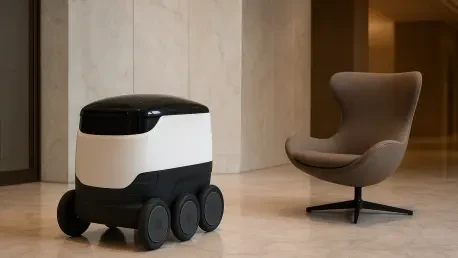

The quiet hum of an autonomous floor scrubber navigating a marble lobby at three in the morning has become the new soundtrack for a sector once defined by the frantic, invisible labor of human night shifts. The hospitality industry is currently undergoing a radical transformation as the lines between science fiction and operational reality blur. Once confined to the heavy machinery of automotive assembly lines, robotics has now entered the lobby, the kitchen, and the guest room. This shift is driven by a convergence of decreasing hardware costs, sophisticated AI integration, and a global labor crisis that has left many service providers struggling to maintain standards. This analysis explores the current trajectory of service automation, analyzing how these technologies move beyond novelty to become essential strategic assets. It examines the data behind this adoption, real-world applications, and the expert perspectives shaping the future of human-robot collaboration in service environments.
Beyond the initial visual appeal of a mechanical concierge, the underlying motivation for this technological pivot is rooted in fundamental economic necessity. The industry is navigating a period where consumer expectations for cleanliness and speed are at an all-time high, while the available pool of human labor remains historically shallow. Consequently, robotics is no longer viewed as a futuristic gimmick designed to attract social media attention. Instead, it is being integrated as a core component of facility management and guest service. This evolution represents a departure from the “gadget” phase of the early 2020s, moving toward a mature ecosystem where machines perform the heavy lifting, allowing human staff to reclaim their role as the emotional heart of the hospitality experience.
The State of Automation: Market Growth and Real-World Implementation
Market Adoption and Statistical Trends
Recent industry reports indicate a significant uptick in the compound annual growth rate for service robotics in the hospitality sector. Data from the International Federation of Robotics and various market analysts suggest that the deployment of professional service robots has increased by over 25% year-over-year. This surge is largely attributed to the rising cost of labor and the high turnover rates that have plagued the industry recently, forcing operators to look for consistent, long-term alternatives for repetitive tasks. From 2026 to 2030, the market is expected to witness even more aggressive expansion as the technology reaches a critical mass of affordability and reliability.
Statistics show that high-volume environments, such as large-scale hotels, transit hubs, and massive entertainment complexes, are leading the charge. In these settings, cleaning and delivery robots see the highest adoption rates because they offer a measurable impact on operational efficiency that is easy to track on a balance sheet. The consistency of a robotic floor scrubber, which does not require breaks or suffer from fatigue, provides a level of standardized cleanliness that is difficult to achieve with a constantly rotating human staff. Moreover, the integration of these units into the broader internet of things (IoT) infrastructure allows managers to receive real-time data on performance, surface coverage, and maintenance needs, further justifying the initial capital expenditure.
The geographic distribution of this growth also highlights a shift in global hospitality standards. While East Asian markets were early adopters, Western Europe and North America have quickly closed the gap, driven by a desperate need to offset labor shortages in the service sector. This trend suggests that the adoption of robotics is not merely a cultural preference for high-tech aesthetics but a pragmatic response to a globalized labor crisis. As more properties demonstrate a successful return on investment, the skepticism that once characterized the industry is being replaced by a race to implement the most efficient autonomous solutions.
Practical Applications in Modern Hospitality
The application of robotics is no longer limited to the novelty of a “receptionist” bot that offers basic information. In the current landscape, sophisticated integration is visible across several key areas, most notably in back-of-house logistics. Autonomous mobile robots (AMRs) are being used in large resorts and stadiums to transport laundry, waste, and food supplies over vast distances. This reduces the physical strain on human staff, who previously spent hours pushing heavy carts through service corridors. By automating these “hidden” tasks, hotels can ensure that their back-of-house operations run like a high-tech fulfillment center, maintaining a seamless flow of materials without increasing headcount.
Kitchen automation has also seen a dramatic rise in sophistication. Notable companies are deploying robotic arms for high-volume food preparation, such as pizza assembly, salad tossing, or burger flipping. These systems are particularly effective in settings like corporate cafeterias or stadium concessions, where consistency and hygiene are paramount. These machines ensure that every portion is identical and that food safety protocols are met with mathematical precision. This does not necessarily eliminate the need for chefs; rather, it allows culinary professionals to focus on recipe development, flavor profiling, and presentation, while the robots handle the repetitive, heat-intensive tasks that lead to burnout.
Environmental services and room delivery represent the most guest-facing aspects of this trend. Automated vacuum units and floor scrubbers are becoming standard in corporate offices and healthcare hospitality, allowing janitorial teams to focus on high-touch point sanitization that requires human attention. In urban centers, compact delivery robots are now a common sight in hotel hallways, having mastered the ability to navigate elevators and avoid obstacles while carrying towels or room service orders. This 24/7 service capability ensures that guest needs are met instantly, even during peak hours when the front desk is overwhelmed with check-ins.
Expert Perspectives on the Technological Shift
Industry thought leaders, including Ashoak Lakhaney of Techality, emphasize that the success of robotics depends entirely on solving real-world problems rather than simply showcasing technical capability. Experts argue that the industry is currently finding its balance because the value proposition varies wildly between different environments. While a robot might be a revolutionary tool in a massive sports arena or a thousand-room resort, it could be an impractical investment in a boutique hotel where the physical space is constrained and the brand identity is built on high-touch human interaction. The consensus among professionals is that the strategic business case must move away from simple labor replacement toward labor augmentation.
By automating low-value, repetitive tasks, businesses can reallocate their human capital to high-value activities that require empathy, complex problem-solving, and personalized guest interaction. The expert community suggests that the true “ROI” of a robot is not just the hours of labor saved, but the increase in guest satisfaction scores that occurs when human employees are no longer too exhausted to smile. However, this shift requires a change in management philosophy. Leaders must view robots as part of a hybrid workforce, requiring the same level of strategic planning and integration as any human department.
There is also a growing dialogue regarding the “readiness” of the hospitality workforce to manage these new mechanical colleagues. Experts point out that the implementation of robotics creates a new category of internal roles focused on robot fleet management, troubleshooting, and data analysis. The goal is to move the hospitality worker up the value chain, turning a housekeeper into a supervisor of a robotic cleaning fleet. This perspective reframes automation as an opportunity for professional development and upward mobility within a sector that has traditionally struggled with stagnant career paths.
Future Outlook: Challenges, Evolution, and Implications
The future of robotics in hospitality will likely be defined by co-existence rather than total replacement. As software becomes more intuitive and sensory hardware more precise, robots are expected to handle increasingly complex environments, including navigating through crowded dining rooms or assisting in eldercare hospitality where gentle interaction is required. However, several significant challenges remain that could slow the pace of adoption. Stakeholder alignment is perhaps the most complex hurdle, particularly in contracted environments like corporate catering or third-party managed facilities. Implementation requires coordination between landlords, facility managers, procurement teams, and health and safety officers, all of whom may have different priorities regarding the use of autonomous machines on their property.
Moreover, the diversity of the hospitality sector—ranging from luxury stadiums to private schools—means there is no one-size-fits-all solution. A robot that excels at vacuuming a flat, carpeted hallway in a corporate office may struggle with the uneven surfaces or heavy foot traffic of a heritage hotel. This lack of scalability across different sub-sectors means that manufacturers must focus on customization and modularity. The ability of a robotic platform to be easily programmed for unique layouts and specific service protocols will be the deciding factor in its commercial success. Operators must be prepared to conduct thorough site audits to ensure that the technology they choose is actually compatible with their specific physical environment.
The human touch remains the core of the hospitality industry, and the broader implication of this trend is a fundamental shift in the workforce where employees must become robot-literate. Managing and working alongside machines will become a standard skill set for hospitality professionals. Economic viability will eventually move from tactical, site-level savings to strategic corporate goals, focusing on sustainability, data collection, and health and safety as the primary drivers of return on investment. Organizations that view automation as a way to enhance the service experience, rather than diminish it, will be the ones that thrive in this new landscape.
Conclusion
The integration of robotics into the hospitality sector represented a measured evolution that prioritized operational resilience over mere spectacle. Successful organizations moved away from the novelty of individual units and instead developed comprehensive automation strategies that aligned with their long-term business goals. These leaders realized that the primary value of a robotic fleet lay in its ability to standardize the mundane, which freed the human workforce to engage in the authentic, empathetic interactions that defined luxury and service. The industry successfully navigated the complexities of stakeholder management and site-specific customization by focusing on data-driven results rather than technical trends.
Operators who thrived in this environment performed detailed audits of their most persistent labor pain points and selected autonomous solutions that offered clear, repeatable benefits. They recognized that the transition to a hybrid workforce required significant investment in staff training and a cultural shift toward viewing technology as an empowering tool. By focusing on labor augmentation, businesses preserved the “human soul” of hospitality while significantly improving their bottom line and health and safety standards. The most effective implementations were those where the robot functioned as an invisible but essential support system, allowing the warmth of human service to remain the primary focus of the guest experience.
Looking back, the adoption of robotics became a catalyst for professionalizing many entry-level roles in the sector, as employees transitioned into high-value positions managing sophisticated technological systems. This shift not only solved the immediate labor crisis but also created a more sustainable and efficient model for global hospitality operations. The organizations that succeeded were those that treated automation as a strategic necessity, ensuring that every mechanical addition served to elevate the brand rather than simply replace a person. Ultimately, the industry proved that technology and humanity could coexist to create a more resilient, responsive, and personalized service environment.