
Katarina Railko is a seasoned hospitality expert whose background in travel and high-stakes event management gives her a unique perspective on large-scale catering operations. In this discussion, we dive into the intricacies of the recent Isle of Wight school catering contract, examining how a focus on 100% local sourcing and a robust social value action plan can transform a community. We explore the logistical demands of serving over 7,000 daily meals, the importance of specialized roles in allergen management, and how modern menus are evolving to match high-street trends while maintaining strict nutritional standards.
Transitioning to 100% local sourcing within an island ecosystem presents unique logistical hurdles. How does a caterer effectively manage these challenges while ensuring daily delivery of thousands of meals?
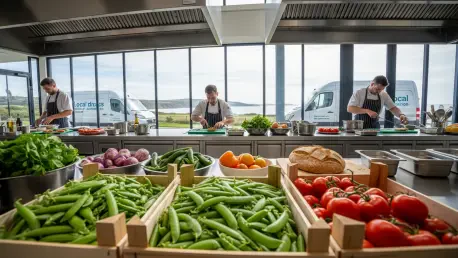
Managing the distribution for such a massive volume—specifically 4,000 primary meals and catering for 3,000 secondary and sixth form students—requires a rock-solid partnership with the local infrastructure. By committing to 100% island-based suppliers like Island Foods and Medina, the caterer isn’t just buying ingredients; they are weaving themselves into the island’s economic fabric. You can almost feel the difference in quality when you move toward a farm-to-table concept; the produce hasn’t spent days in the back of a cross-country truck. This approach requires precise coordination with island logistics to ensure that the three-week rolling menu remains consistent without the safety net of mainland wholesalers. It’s a bold move that keeps every penny of investment within the local ecosystem, providing both a sensory and economic boost to the region.
With the introduction of specialized roles like medical diet coordinators, how is the landscape of school catering shifting to address the complexities of student health and dietary restrictions?
We are seeing a significant shift where catering is becoming as much about health management as it is about food service. The creation of a dedicated medical diet coordinator role is a direct response to the skyrocketing demand for allergen-centered menus that require expert oversight. Parents need to feel an absolute sense of trust when their children sit down for a two-course meal at school. By having nutrition teams oversee tailored allergen-managed menus, the operation moves beyond simple substitution to a high-level, inclusive dining experience. This ensures that every student, regardless of their medical needs, can enjoy the same social experience of a school lunch without the fear of a reaction.
Balancing the strict requirements of School Food Standards with the desire to offer “high street” style menus for older students is a delicate act. What strategies are being used to keep menus engaging yet nutritious?
The key is to mirror the “grab and go” culture that older students see in the real world while keeping the ingredients within healthy boundaries. For primary pupils, comfort is king with dishes like mac and cheese, but for the sixth formers, the menu has to feel like a high-street cafe to keep them on campus. Dishes like fish and chips with peas offer that familiar, savory satisfaction but are prepared to meet specific standards that you wouldn’t necessarily find at a local takeaway. By updating the offering to include trending tastes, the caterer ensures that students aren’t just eating because they have to, but because they are genuinely excited by the menu. It’s about creating a sensory experience that competes with external food options through variety and quality.
Beyond the plate, the contract emphasizes sustainability and climate training. In what ways do these environmental initiatives influence the broader education of the students involved?
Sustainability is no longer a “nice to have” feature; it’s an integrated part of the educational curriculum through the food program. By introducing low carbon and carbon labeling directly on the menus, students are given the data they need to make informed choices every single day. This is paired with climate training for staff to ensure that the operations themselves—serving those 7,000 daily meals—are as resource-efficient as possible. It creates a circular learning environment where the “farm to table” philosophy is visible in every bite, helping to reduce the overall carbon footprint of the entire school network. When students see the impact of their food choices on their own island, it fosters a much deeper connection to environmental stewardship.
What is your forecast for the future of localized school catering?
I anticipate a massive shift toward “hyper-localism,” where large-scale caterers will increasingly ditch national supply chains in favor of regional hubs to meet social value goals. As we see with the Isle of Wight model, the ability to adapt to specific regions and use specialized roles like chef ambassadors to engage the community will become the industry standard. We will likely see more contracts requiring 100% local sourcing as a baseline, forcing suppliers to innovate within their own backyards. This evolution will not only improve the freshness and quality of student meals but will also turn school dining halls into vital engines for local economic growth and sustainability.