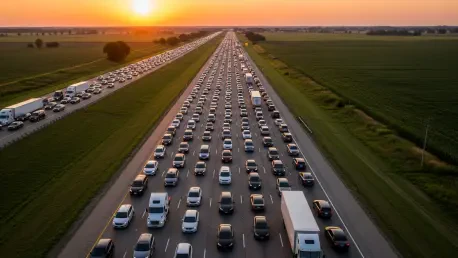

The unprecedented surge of nearly seventy million American travelers during the 2026 Independence Day holiday pushed the nation’s fragile transportation network to its ultimate breaking point, causing a systemic failure that was most visible across the Midwestern United States. This historical disruption transformed a typical seasonal celebration into a logistical nightmare, exposing the critical vulnerabilities of aging infrastructure that has long been neglected in the “West North Central” region. As highways became impassable and airport terminals reached total capacity, the resulting gridlock demonstrated how easily localized issues in the American heartland can trigger a massive cascade of failures, effectively paralyzing the domestic transit system from coast to coast. The breakdown was characterized by an unprecedented “feedback loop” where ground congestion and aviation delays reinforced one another, leaving millions of passengers stranded without viable alternatives or reliable information. This crisis highlighted the dangerous exhaustion of the current transportation capacity, serving as a stark reminder that the existing resource model used by major airlines and transit authorities is no longer sufficient to handle the demands of modern American mobility.
Regional Breakdown and the Bottleneck Effect
The Suffocation of Midwestern Hubs
The four-state corridor encompassing Iowa, Nebraska, Kansas, and Missouri served as the primary epicenter of infrastructure suffocation throughout the holiday weekend. With more than five million travelers attempting to navigate this specific gateway, the regional highway network reached a point of saturation where outbound flow was effectively capped at a standstill. What was originally projected as a routine, albeit heavy, holiday commute quickly devolved into a high-stakes logistical gamble for both private citizens and commercial transport services. In this environment, maintaining a predictable travel schedule became nearly impossible, as the sheer density of vehicles on primary arteries like I-80 and I-29 far exceeded the engineered capacity of these aging routes. This density did not just slow down traffic; it created a physical barrier to movement that prevented the efficient distribution of resources and personnel across the central states. Consequently, the regional economy suffered a significant blow as the movement of goods and services was halted alongside the holiday travelers, illustrating the deep interconnectedness of civilian transit and commercial logistics within the nation’s heartland.
The geographic positioning of these states as a central bridge for national travel meant that the local paralysis had immediate and severe repercussions for the rest of the country. When the “West North Central” region stopped moving, the ripple effects were felt from the Pacific Northwest to the Atlantic seaboard, as long-haul trucking and connecting flights were caught in the Midwestern bottleneck. State transportation departments reported that the volume of traffic was not merely high, but structurally overwhelming, leading to a total loss of flow control on several major interchanges. This suffocation was not limited to the highways alone, as it effectively trapped local populations within their own metropolitan areas, preventing even short-range travel for emergency or essential purposes. The inability to clear these bottlenecks in a timely manner suggested that the current infrastructure is not only outdated but fundamentally incapable of supporting the peak demand levels that have become common in the middle of the decade. This event has forced a reevaluation of how the nation views regional transit, shifting the focus toward the necessity of massive capacity increases in the central United States.
Hubs Under Pressure: Ground Transit Disruption
In critical urban centers such as Des Moines and Omaha, the extreme pressure on airport access roads proved to be the ultimate deciding factor in the total regional aviation collapse. As the interstate corridors leading into these hubs transformed into massive, immobile parking lots, the critical communication bridge between ground transportation and flight operations began to crumble. Many travelers who had planned for significant delays still found themselves unable to reach their departure terminals, resulting in a staggering wave of missed check-ins that the airlines were entirely unprepared to manage. The resulting backlog of displaced passengers overwhelmed terminal staff and automated booking systems alike, leading to a series of unannounced flight cancellations that compounded the frustration of the stranded public. By the time many individuals successfully reached the ticketing counters, their seats had already been reassigned to standby travelers, creating an agonizing cycle of holding patterns within terminal lounges. This specific failure point demonstrated that even if aircraft are ready for departure, the inability of passengers to physically access the airport facility can still bring the entire national aviation network to its knees.
The breakdown in communication between ground transit providers and the aviation sector worsened as the holiday progressed, revealing a lack of integrated data sharing that might have mitigated the crisis. Shuttle services and ride-share drivers were caught in the same gridlock as their passengers, rendering “guaranteed” airport transfers useless and leaving travelers with no viable way to bridge the last five miles to their gates. This logistical disconnect meant that airlines were operating flights with half-empty cabins while thousands of ticketed passengers were stuck just a few miles away on the freeway. The chaos within the terminals was further exacerbated by the lack of physical space to accommodate the growing crowds of displaced travelers, leading to safety concerns and a total breakdown of order in several regional hubs. Authorities noted that the infrastructure surrounding these airports had not kept pace with the growth of the cities themselves, creating a permanent bottleneck that only required a minor surge to trigger a complete system shutdown. The holiday collapse served as a definitive proof of concept for the “last mile” problem, where the failure of local access roads can negate the efficiency of the entire global aviation industry.
Analyzing the Mechanics of Structural Failure
A Predictable Systemic Saturation
Industry experts from the Department of Transportation and AAA have reached a consensus that this catastrophe was not an unpredictable fluke caused by extreme weather, but rather a structural failure of a legacy network. The American travel system currently relies on an infrastructure framework designed decades ago, which simply cannot accommodate modern demand peaks driven by evolving cultural traditions and concentrated school breaks. This predictable surge exposed a deep fragility in how the nation manages its most vital transit arteries, showing that the system has no margin for error or excess capacity. When a network is consistently pushed to its theoretical limit, even the smallest disruption can cause the entire structure to buckle under the weight of its own inefficiency. Experts pointed out that the current growth in traveler numbers has far outpaced the rate of infrastructure investment, leading to a situation where saturation is the default state during any major holiday period. This structural deficit is particularly acute in the Midwest, where the distance between major hubs makes the system highly dependent on a small number of critical routes that lack redundancy.
The failure was also a result of a reliance on “just-in-time” resource management within the transportation industry, which leaves no room for the unexpected delays that are inevitable during high-volume periods. Airlines and transit authorities have optimized their operations for maximum efficiency during average conditions, which paradoxically makes them more vulnerable to total collapse during peak periods. This lean operational model means that when a bottleneck occurs, there are no spare crews, aircraft, or buses available to absorb the shock or clear the backlog. Consequently, a minor issue that would be a nuisance on a Tuesday afternoon becomes a catastrophic event on a holiday weekend, as the system lacks the “buffer” necessary to recover from a disruption. The systemic saturation witnessed during the 2026 holiday is a clear indication that the nation can no longer afford to operate on the edge of capacity. Without a fundamental shift toward building excess capacity and redundancy into the network, these types of structural failures will continue to occur with increasing frequency and severity, undermining the reliability of the entire American transportation landscape.
Cascading Failure: The Interconnectivity Problem
This event is best described as a “rolling failure,” where a single accident or delay creates a chain reaction that spreads across different sectors and geographic regions. For example, a minor multi-vehicle crash on an Iowa interstate did more than just delay local commuters; it caused a series of missed connections that eventually grounded flights as far away as Chicago and New York. When a passenger or a flight crew member is trapped in highway gridlock in Omaha, the downstream effects are immediate, as the aircraft they were supposed to board cannot depart, leading to further cancellations throughout the day. This interdependency means that the entire national network is only as strong as its weakest regional link, which during this holiday was clearly identified as the Midwestern corridor. The cascading nature of the disruption made it nearly impossible for travelers to plan around the chaos, as a delay in one part of the country would manifest as a cancellation in another without any apparent local cause. This lack of resilience is a direct consequence of a highly integrated but poorly supported national transit system.
The “rolling failure” phenomenon also highlighted the limitations of modern scheduling software, which struggled to re-calibrate in the face of such widespread and unpredictable data points. As the day progressed, the sheer number of variables—from highway speeds to crew legality hours—created a computational overload that left many airline dispatchers working with outdated or incorrect information. This led to situations where planes were sent to gates that were already occupied or crews were timed out while sitting in traffic, further slowing the recovery process. The interconnectivity of the system turned every small delay into a multiplier, ensuring that the initial gridlock in the heartland would eventually impact the entire continental flight schedule. This event proved that the American infrastructure is no longer a collection of independent regional networks, but a single, massive machine where a jam in the central gears can bring the entire apparatus to a halt. Recognizing this reality is the first step toward developing a more robust management strategy that accounts for the reality of cascading failures in a hyper-connected world.
The Human and Economic Toll
Financial Loss and Economic Consequences
The impact on passengers went far beyond mere inconvenience, evolving into a period of intense anxiety and significant financial strain for millions of households. Families facing ruined vacations and missed milestone events were forced to absorb the high costs of fluctuating gas prices and emergency hotel stays as they waited for the gridlock to clear. Furthermore, the loss of control over travel itineraries led to a massive operational cost for individuals who were forced to rebook tickets at peak holiday rates when their original plans fell through due to missed connections. For many, the financial burden of the holiday collapse exceeded the original cost of their entire trip, turning a planned celebration into a significant economic setback. The broader regional economy also suffered, as local businesses dependent on the influx of holiday tourists saw a sharp decline in revenue when travelers were unable to reach their destinations. This loss of economic activity in the hospitality and service sectors highlights the direct link between infrastructure reliability and the financial health of the American heartland.
Beyond the immediate costs to travelers, the infrastructure collapse incurred long-term economic damage through the disruption of supply chains and commercial logistics. The heavy freight that shares the Midwestern interstates with holiday travelers was also caught in the standstill, leading to delays in the delivery of perishable goods and critical industrial components. This slowdown in the movement of goods adds a layer of inflationary pressure to the economy, as the increased costs of transport and the loss of productivity are eventually passed on to the consumer. The 2026 holiday crisis demonstrated that a failing transportation network is a massive hidden tax on every American, reducing the overall efficiency of the economy and discouraging future investment in the region. To address these financial risks, there is a growing demand for a dedicated infrastructure fund that can provide the necessary capital for large-scale modernization projects. Without a stable and reliable transit system, the economic potential of the Midwest remains capped by the physical limitations of its roads and runways, preventing the region from reaching its full growth potential in the late 2020s.
Public Safety: The Cost of Congestion
Public safety became a critical concern as the extreme congestion led to historically high rates of traffic accidents and medical emergencies on the road. Driver fatigue, combined with the intense frustration of being stranded indefinitely in high-temperature conditions, contributed to a dangerous environment on the highways, placing an extra burden on emergency responders. These responders were already struggling with the gridlock themselves, as the lack of emergency lanes and the density of the traffic made it nearly impossible for ambulances and fire trucks to reach the scenes of accidents quickly. Authorities emphasized that the crisis was a public health issue as much as a logistical one, highlighting the dangers of a system pushed past its limits where basic safety protocols can no longer be guaranteed. The psychological toll on drivers and passengers was also significant, with reports of road rage and heat-related illnesses increasing as the duration of the delays stretched from hours into days. This environment created a perfect storm of risk factors that challenged the capabilities of local and state law enforcement agencies.
The congestion also highlighted the lack of roadside infrastructure capable of supporting large numbers of stranded people for extended periods. Rest areas were quickly overwhelmed, leading to sanitation issues and a shortage of food and water for those stuck in the gridlock. This lack of support services turned a traffic delay into a survival situation for many travelers, particularly the elderly and those with pre-existing medical conditions who required regular access to medication or climate-controlled environments. Public safety officials have noted that the current design of the interstate system does not account for the possibility of total stagnation, leaving the public vulnerable when the “flow” of traffic stops completely. The holiday collapse has served as a wake-up call for the need to integrate emergency management and public health considerations into future infrastructure planning. Ensuring that travelers have access to basic necessities and medical care during a systemic failure is now seen as a priority for state and federal agencies tasked with protecting the American public during times of mass transit.
Navigating an Unstable Future
Strategic Adaptation for Modern Travelers
In response to the persistent threat of infrastructure collapse, travelers are being urged to adopt new strategies for survival in an increasingly unpredictable transit landscape. Digital vigilance has become an absolute necessity, with mobile apps and real-time data feeds being the only reliable way to bypass communication blackouts at crowded terminals and gridlocked interchanges. Travelers are now advised to monitor multiple sources of information simultaneously, as official announcements often lag behind the reality on the ground during a fast-moving crisis. Additionally, the standard “buffer time” for trips through the Midwest must be radically expanded, forcing people to treat holiday travel as a high-stakes exercise in risk management rather than a simple leisure activity. This shift in mindset requires a greater level of personal preparation, including the carrying of emergency supplies and the development of alternative route plans that avoid the major hubs altogether. While these individual adaptations can help mitigate the impact of a collapse, they do not address the underlying structural issues that make such measures necessary in the first place.
Building on this need for adaptation, the role of technology in personal travel management has expanded to include sophisticated predictive analytics that help travelers identify potential bottlenecks before they occur. Many are now using AI-driven platforms to simulate their trips under various conditions, allowing them to make informed decisions about when to depart or whether to cancel a trip entirely. This proactive approach to travel is becoming the new norm for frequent commuters in the “West North Central” region, who have learned through experience that the legacy system cannot be trusted during peak periods. However, this reliance on technology also creates a digital divide, where those without access to the latest tools or high-speed data are at a significant disadvantage during a systemic failure. The adaptation of the traveling public is a testament to American resilience, but it also reflects a growing lack of confidence in the state’s ability to provide a functioning and reliable transportation network. As the decade progresses, the burden of managing infrastructure failure is increasingly being shifted onto the individual traveler, who must navigate a broken system with limited support.
Modernization: A Roadmap for Resilience
The 2026 holiday crisis ultimately functioned as a definitive warning that the current American infrastructure model reached the end of its functional life. The events of the Independence Day weekend proved that incremental updates are no longer sufficient to protect the domestic tourism industry or the safety of the traveling public. To avoid a repeat of this systemic failure, the primary focus for policymakers shifted toward the rapid deployment of high-speed rail corridors and the significant expansion of regional airport capacity in the Midwest. These projects represent the only viable path forward to decouple highway congestion from aviation reliability, ensuring that a single point of failure on the ground cannot again paralyze the entire nation. Travelers were encouraged to treat these modern infrastructure investments not as luxuries, but as essential components of a resilient national security and economic strategy. By prioritizing these structural overhauls, the nation can transition away from a reactive model of crisis management toward a proactive system capable of supporting the robust mobility demands of the late 2020s.
Actionable next steps involve the immediate authorization of federal grants aimed at creating redundant transit paths that bypass the current regional bottlenecks. This includes the development of secondary airport hubs that can handle diverted traffic when primary terminals like Omaha or Des Moines are overwhelmed, as well as the implementation of “smart highway” technologies that can dynamically manage traffic flow during surges. Furthermore, the integration of ground and air transit data must be mandated to ensure that airlines are not flying empty planes while passengers are stuck in gridlock. Future considerations must also include the environmental impact of these expansions, seeking sustainable solutions that can scale with the growing population. The lessons learned from the 2026 collapse highlighted the need for a holistic approach to infrastructure that values reliability and safety over short-term cost savings. By investing in a modernized, interconnected, and resilient network now, the heartland can be transformed from a national bottleneck into a high-efficiency engine for the country’s continued mobility and prosperity.