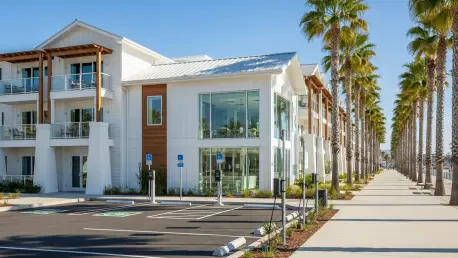

The current landscape of commercial real estate exhibits a stark divergence where traditional office and retail spaces struggle, yet premium coastal hospitality assets have emerged as some of the most resilient and profitable vehicles for institutional capital. While many real estate sectors face uncertainty, these assets are demonstrating remarkable resilience, fueled by a unique convergence of record-high leisure demand and strategic asset modernization. In the current economic climate, investors are increasingly gravitating toward “recession-proof” coastal hubs where limited supply and high barriers to entry protect profit margins. This analysis explores the shift toward high-yield coastal properties, examining the impact of brand-led renovations, the stabilization provided by institutional demand, and the future of coastal tourism development.
Resilience and Growth in Prime Coastal Markets
Analyzing Key Performance Metrics and Market Adoption
Recent industry reports highlight a surge in Average Daily Rate (ADR) and Revenue Per Available Room (RevPAR) within coastal sub-markets, often outperforming urban cores. Data indicates that premium coastal assets are achieving RevPAR indices as high as 145 percent, signaling a strong traveler preference for modernized, well-located beachfront properties. Investment capital is increasingly flowing into regions that offer a “dual-threat” demand profile, blending traditional leisure tourism with year-round institutional business from medical and educational sectors.
This balanced demand helps mitigate the risks typically associated with seasonal fluctuations, creating a reliable income stream that appeals to conservative lenders. Moreover, as of May 2026, market leaders have seen occupancy indices rise significantly above their competitors, proving that consumers are willing to pay a premium for quality. This trend suggests that the hospitality sector’s recovery is not uniform but is instead concentrated in high-demand geographic pockets that offer experiential value.
Modernization as a Competitive Advantage: The Hampton Inn Galveston Case Study
Real-world application shows that properties undergoing comprehensive renovations experience immediate market leadership and enhanced liquidity. For example, the recent four million dollar upgrade of the Hampton Inn & Suites Galveston, which modernized guestrooms and public spaces, allowed the property to command a dominant position in its market. The fulfillment of Property Improvement Plans (PIP) prior to sale has become a critical trend, allowing buyers to acquire assets with minimal immediate capital expenditure requirements.
The strategic listing of high-performing assets through major advisory firms like HVS highlights the demand for turnkey hospitality investments in secondary coastal markets. Investors are prioritizing properties in excellent physical condition to avoid the volatility of construction costs and labor shortages. By acquiring an asset that already meets brand standards, new owners can focus entirely on operational efficiencies and revenue management rather than managing complex renovation timelines.
Strategic Brand Alignment and Operational Flexibility
Industry thought leaders emphasize the growing importance of long-term franchise stability, noting that fifteen-year brand agreements with global leaders like Hilton provide essential security for institutional lenders. Such agreements ensure access to powerful global reservation systems and loyalty programs that drive occupancy even during broader economic cooling. Experts argue that “unencumbered by management” offerings are the new gold standard, providing purchasers the vital flexibility to install specialized management teams or self-operate to maximize cash flow.
The consensus among hospitality analysts is that properties capable of commanding a price premium post-renovation are best positioned to weather inflationary pressures. By securing assets that have already addressed major capital needs, investors can pivot their focus from construction management to operational excellence. This flexibility allows for rapid adjustments in pricing strategies to match real-time market demand, effectively hedging against rising labor and utility costs that have squeezed margins in less modernized facilities.
Navigating the Long-Term Horizon: Institutional Growth and Regional Synergy
The future of coastal investment is increasingly tied to large-scale regional developments, such as the one billion dollars in projects currently transforming the Galveston coastline. Expansion of cruise terminals and the introduction of mega-resorts are expected to create a “halo effect,” driving occupancy and revenue growth for existing limited-service and boutique hotels. These large-scale infrastructure investments signal a long-term commitment to the region’s viability as a premier travel destination, attracting a more diverse demographic of visitors.
Beyond the allure of the beach, the diversification of demand through universities and medical centers provides a stabilizing floor for valuations. Institutions like the University of Texas Medical Branch and Texas A&M University at Galveston generate consistent, non-seasonal room nights that insulate owners from the volatility of the vacation market. Projections for high-performing coastal assets suggest sustained revenue growth through the late 2020s, driven by a permanent shift in consumer spending toward experiential travel and the continued expansion of regional transit hubs.
Strategic Conclusions for Hospitality Investors
This analysis confirmed that the intersection of modern physical condition, brand strength, and regional economic growth made coastal hospitality a premier target for capital deployment. Investors who prioritized assets with satisfied property improvement plans successfully avoided the rising costs of construction materials and labor. By targeting markets with diverse demand drivers, stakeholders ensured that their portfolios remained productive regardless of shifts in discretionary spending. The reliance on established global brands proved to be a vital safeguard for maintaining occupancy levels and securing favorable financing terms.
Success in this sector required identifying assets that had already addressed capital needs, leaving the new owner to focus entirely on operational excellence and yield management. Future strategies should involve a deeper integration of local economic data, such as university enrollment and cruise ship schedules, to optimize daily rates. As coastal markets evolved into sophisticated year-round hubs, the window for acquiring high-index, turnkey assets represented a significant opportunity for long-term value appreciation. The transition toward a more institutionalized hospitality landscape rewarded those who recognized the synergy between brand reliability and regional economic expansion.