
Katarina Railko is a distinguished expert in the hospitality industry, having spent years refining her craft within the high-stakes world of international travel and tourism. With a background that spans across the entertainment and events sectors, she has become a leading voice on the evolution of expos and large-scale conferences. Her unique perspective combines operational excellence with a deep understanding of consumer behavior, particularly in emerging markets where cultural nuances dictate success. Today, she joins us to discuss the transformative shifts occurring in the Indian hospitality landscape, a sector that is currently redefining itself through internal demand and regional expansion.
In our conversation, we explore the powerful surge of domestic tourism and how it has become the primary engine for economic growth within the subcontinent. We examine the strategic shift of investment from massive metropolitan hubs to burgeoning Tier 2 and Tier 3 cities, supported by significant government-led infrastructure projects. Katarina also sheds light on the rising demand for experiential and pilgrimage travel, the complexities of managing a workforce in a fragmented market, and the critical talent shortages that pose a risk to the industry’s rapid scaling.
With domestic travelers now driving roughly 85% of all tourism spending in India, how is this internal demand reshaping the long-term strategies of hotel operators who once prioritized international visitors?
This is a massive pivot for the industry because it moves the focus from seasonal, inbound peaks to a model that requires sustained, year-round engagement. In 2024 alone, we saw an estimated 2.9 billion domestic tourist visits, a number that is truly staggering and points to a middle class that is more mobile and eager to explore than ever before. This domestic engine provides a level of resilience that international markets simply cannot match, especially as we saw the sector bounce back with incredible speed following the pandemic. For operators, this means pricing models, marketing campaigns, and even hotel amenities must cater to the local palate and cultural expectations rather than just a Westernized standard. It’s no longer about waiting for the winter influx of foreign tourists; it’s about capturing the steady, vibrant pulse of local families and business travelers who are traversing the country every single day.
The industry is seeing a remarkable movement beyond metros like Mumbai and Delhi, with significant growth in Tier 2 and Tier 3 cities. What are the primary catalysts behind this geographical shift into the heart of India?
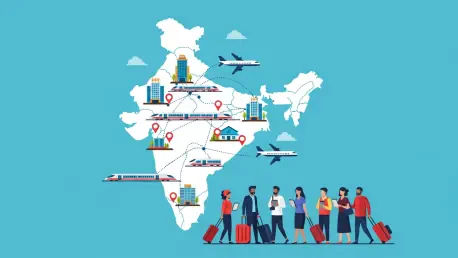
The expansion into cities like Coimbatore, Surat, and Bhubaneswar is being fueled by a perfect storm of government initiative and corporate decentralization. Projects like the Smart Cities Mission and the UDAN regional air connectivity scheme have opened doors to previously underserved areas, making it physically and economically viable to build high-quality accommodations there. We are seeing that roughly half of all hotel transactions are now occurring in these Tier 2 and Tier 3 cities, which is a clear signal that the smart money is moving away from the saturated metros. As industries move their operations to these emerging hubs, business travel follows, creating a year-round demand for reliable lodging. This isn’t just about small-scale guesthouses; the branded hotel supply is aggressively targeting these destinations to provide the consistency and quality that modern domestic travelers now expect.
It is often said that every 100 kilometers in India, the language, cuisine, and clothing change. How do hospitality brands manage to maintain a sense of consistency while respecting such intense regional fragmentation?
Navigating a market that functions more like a collection of distinct nations than a single country is the ultimate challenge for any operator. You have to balance the global standards of a brand with the hyper-local reality of the guest’s experience, where the flavor of a morning meal or the dialect spoken at the front desk can make or break the stay. Successful operators are the ones who don’t just “plant” a cookie-cutter hotel in a new city but instead hire local frontline staff who bring an authentic, culturally grounded presence to the property. This local knowledge is an asset that cannot be taught in a corporate manual; it’s about the sensory details, the emotional connection, and the specialized service mindset that reflects the specific region. When the culture changes every 100 kilometers, your leadership must be agile enough to adapt the format of the hotel to the soil it stands on while keeping the core brand promise intact.
Experiential travel in India is projected to become a $45 billion market by 2027. In a culture so rich with history, what are modern travelers looking for beyond the traditional landmarks and monuments?
The modern traveler is moving away from the “checklist” style of tourism where you just take a photo of a monument and move on. Today’s guests, particularly the younger demographic, are looking for a deep, immersive connection that makes them feel like a participant in the local culture rather than just an observer. This shift is giving less weight to product-based luxuries, like the thread count of the bedsheets, and much more to the emotional and sensory journey of the stay. We see this very clearly in the massive share of the market held by religious and pilgrimage tourism, which remains a cornerstone of the domestic travel experience. People want to feel something authentic—whether it’s a specific regional culinary workshop or a guided spiritual journey—and they are willing to invest heavily in these personal, high-value experiences.
As the industry scales, there is a growing concern regarding a talent and leadership gap. How critical is this workforce shortfall, and what does it mean for the quality of service in the coming decade?
The talent gap is perhaps the most significant bottleneck facing the Indian hospitality sector today, with the WTTC predicting it will be the second-largest labor shortfall among the world’s major economies. While India has a massive labor pool, there is a distinct misalignment between the speed of hotel openings and the availability of skilled professionals with the right service mindset. We are seeing a situation where experienced managers are being stretched thin, often being moved from established metros to lead new properties in Tier 2 cities before they are fully seasoned. This creates a vacuum of strategic capability at the top and can lead to inconsistent service on the front lines. Furthermore, the industry is competing for talent with the aviation, retail, and tech sectors, which often offer perceived better working conditions, making retention a constant, uphill battle for hotel operators.
With India becoming a global powerhouse for conferences, exhibitions, and MICE tourism, how is the business travel segment influencing the design and functionality of new hotel developments?
The rise of India as a premier destination for large-scale conferences and exhibitions is fundamentally changing the blueprint of new hotels. We are no longer seeing properties built solely for leisure; they are now multi-functional hubs designed to host hundreds of delegates with high-tech meeting spaces and massive banquet facilities. This is particularly visible in industrial cities where business travel is the primary driver, and the demand for upscale and midscale branded supply is soaring. These hotels have to be efficient engines of productivity during the day and offer high-quality relaxation in the evening to satisfy a very discerning corporate traveler. Because business travel is no longer confined to the “Big Three” cities, these specialized facilities are popping up in regions that were previously ignored by major developers, further integrating the national economy.
What is your forecast for the Indian hospitality market?
My forecast for the Indian hospitality market is one of sustained, aggressive growth, though it will be characterized by a “survival of the most adaptable” mentality. With the GDP already over $4 trillion and the middle class expanding at a breakneck pace, the sheer volume of travelers will continue to break records, likely doubling the current domestic visit numbers by the end of this decade. I expect we will see a massive consolidation of branded midscale hotels in regional hubs as they replace unorganized local players who cannot keep up with rising guest expectations. However, the real winners will be the operators who solve the human capital puzzle—those who can train and retain a workforce that delivers authentic, experiential service in a fragmented market. If the industry can bridge the talent gap and continue to leverage government infrastructure projects, India will not just be a global player; it will become the definitive blueprint for how a domestic-led hospitality economy can thrive.