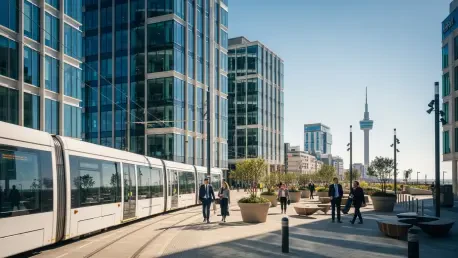

Katarina Railko is a seasoned expert in the hospitality and travel sectors, with a deep understanding of how large-scale urban regeneration transforms local economies. Her experience in managing high-level hospitality brands and major conferences makes her uniquely qualified to discuss Blackpool’s evolution from a seasonal seaside resort into a year-round business hub. We explore the massive £350 million Talbot Gateway development, the shift toward a 365-day tourism model, and how the “mini-Canary Wharf” effect is attracting international investment and thousands of professionals to the Lancashire coast.
The Talbot Gateway project is effectively creating a “mini-Canary Wharf” within Blackpool. How does establishing a central business district change the town’s traditional identity, and what specific strategies ensure the needs of 8,000 new workers and students are met alongside existing tourism?
The shift toward a “mini-Canary Wharf” model is a bold departure from Blackpool’s historical identity as a purely seasonal getaway, but it is a necessary evolution for long-term survival. By developing a 20-acre central business district, the town is signaling to the world that it is open for high-stakes commerce every day of the year, not just during the summer holidays. To balance the needs of 8,000 new workers and students with traditional tourists, the strategy focuses on creating a mixed-use civic quarter that blends professional infrastructure with leisure. This includes the development of the 125,000-square-foot Bickerstaffe Square headquarters and a massive 120,000-square-foot supermarket, ensuring that the daily necessities of a professional workforce are integrated into the heart of the resort. Ultimately, this diversification stabilizes the local economy by providing a steady stream of foot traffic that supports local businesses even when the vacation season ends.
Local hospitality has seen a 140 percent surge in corporate guests and provided over 20,000 rooms for conference delegates. What specific service standards are necessary to manage this volume, and how do you tailor the guest experience to satisfy both international business travelers and domestic vacationers?
Managing a 140 percent surge in corporate demand requires a meticulous approach to service that prioritizes efficiency without losing the warmth of local hospitality. For a flagship property like the 144-bedroom Holiday Inn, maintaining the title of the “Best Holiday Inn in the UK and Ireland” involves a rigorous commitment to quality that has already satisfied over 150,000 guests since its opening. We focus on a dual-track guest experience: international business travelers expect seamless connectivity and high-tier amenities, while domestic vacationers seek emotional value and sensory engagement with the town’s attractions. To deliver this, the project has created 100 jobs for local residents, ensuring that the staff possesses an authentic passion for the area that resonates with every visitor. By delivering over 20,000 rooms specifically for conference delegates, the resort has proven it can handle high-capacity events while maintaining the bespoke feel of a luxury destination.
With the upcoming arrival of 3,000 civil servants at the new DWP regional office and 1,100 MoD staff, the local population density is shifting. How will the new tramway extension and station interchange handle this daily influx, and what impact will this have on local transit logistics?
The logistical heart of this transformation is the new tramway extension and the sophisticated interchange at the train station, which are designed to act as a seamless conduit for thousands of daily commuters. With 3,000 civil servants moving into the seven-story, 215,000-square-foot DWP office by 2025 and another 1,100 MoD staff arriving shortly after, the pressure on transit infrastructure is significant. These upgrades are not just about moving people; they are about connecting the regional economy to the national rail network, making the town center accessible for high-level professionals. This transit-oriented development reduces the reliance on traditional car travel, which is essential when you consider the increased density within the 20-acre regeneration zone. By integrating the tramway directly with the train station, Blackpool is creating a modern, European-style urban flow that supports a 24/7 economy.
The Multiversity campus is designed as a carbon-neutral facility for 3,000 students and staff. How does integrating a high-tech academic hub into a coastal resort drive long-term economic stability, and what role does sustainable architecture play in attracting modern private investment to the region?
Integrating the £65 million Multiversity campus into the town center is a masterstroke for long-term economic stability because it anchors a permanent population of 3,000 students and staff in the heart of the district. This academic hub serves as a talent pipeline, ensuring that the high-growth industries moving into the region have a ready supply of skilled local workers. The decision to make the facility carbon-neutral is also a strategic signal to private investors who are increasingly focused on Environmental, Social, and Governance (ESG) criteria. Sustainable architecture acts as a “green magnet,” proving that Blackpool is a forward-thinking environment capable of supporting modern, ethical business practices. When private firms see a £65 million commitment to sustainable education, it de-risks their own investments and encourages them to participate in the town’s regeneration.
The Lancashire Growth Plan aims to secure over £20 billion in additional investment across five high-growth sectors. Which specific industries are most likely to capitalize on this infrastructure, and what metrics should regional businesses track to ensure they are positioned to benefit from this capital?
The £20 billion investment target is aimed at sectors that can leverage Blackpool’s unique combination of high-tech infrastructure and global hospitality appeal. While the plan focuses on five key growth areas, industries like digital technology, civil service administration, and sustainable energy are prime candidates to capitalize on the new office spaces and carbon-neutral facilities. Regional businesses should keep a close eye on metrics such as commercial occupancy rates, which are already bolstered by the massive 215,000-square-foot DWP regional office. Additionally, tracking the growth in international visitor numbers—particularly the surge from the USA—can help local entrepreneurs tailor their services to high-spending global markets. By monitoring these indicators, local stakeholders can ensure they are moving in lockstep with the broader regional expansion.
Transitioning from a seasonal destination to a 365-day international hub requires significant logistical changes. How is the resort successfully penetrating global markets like the USA, and what anecdotes can you share regarding the challenges of maintaining a high-quality hospitality brand during such rapid expansion?
Penetrating the US market has been a significant milestone, driven by the resort’s ability to project itself on a global stage as a sophisticated, year-round destination. We have seen the American market grow substantially, as international travelers are drawn to the rare combination of a historic coastal brand and a brand-new, £350 million business infrastructure. One of the primary challenges of such rapid expansion is maintaining an elite service standard; it is one thing to open a hotel, but quite another to be ranked as the best in the country for two consecutive years. This success is rooted in the “ambassador” mindset of our 100-strong local workforce, who treat every corporate delegate with the same level of care as a traditional holidaymaker. The challenge lies in the details—ensuring that a conference guest who has traveled thousands of miles feels the unique charm of the Lancashire coast while receiving world-class professional service.
What is your forecast for Blackpool’s hospitality sector?
My forecast for Blackpool’s hospitality sector is one of sustained, transformative growth that will eventually see the town become a primary rival to major UK business hubs. With the groundwork laid by the £350 million Talbot Gateway and the potential for a portion of that £20 billion in regional investment, I expect to see a permanent shift where corporate revenue accounts for more than half of the town’s annual hospitality income. We will likely see a “clustering effect” where more private firms relocate to be near the 4,000+ government and defense staff, further driving up the demand for high-end hotel rooms and conference facilities. By 2028, when the Multiversity is fully operational, Blackpool will no longer be seen as just a “resort,” but as a thriving, carbon-conscious coastal city with a 365-day international audience.