
The landscape of the United Kingdom event industry is undergoing a profound structural shift as planners move away from traditional functional spaces in favor of environments that offer a seamless fusion of heritage, advanced technology, and high-level hospitality. This evolution is no longer a matter of simple aesthetic upgrades; it is a calculated response to a more demanding corporate audience that expects every venue to facilitate both digital connectivity and physical engagement simultaneously. As organizers look toward the 2026 to 2028 period, the pressure to provide visually stunning yet technically flawless backgrounds has prompted a wave of multi-million pound investments across London and beyond. From the meticulous restoration of centuries-old landmarks to the ground-up development of tech-forward social hubs, the market is redefining what it means to be a versatile space. This transformation highlights a commitment to creating site-specific experiences that resonate with a global workforce that is increasingly mobile and tech-savvy in its professional and personal lives.
Integrating Advanced Production: Traditional Hospitality
The refurbishment of The Tower Suite at The Tower Hotel by Thistle provides a quintessential example of how production-led capabilities are becoming the standard for modern corporate hubs. By prioritizing integrated digital signage and high-definition projection systems, the venue has moved beyond the need for external audiovisual rentals, offering a plug-and-play solution for planners. The inclusion of retractable ceiling rigging allows for complex lighting and branding setups that were previously impossible without significant structural modification. This 500-capacity space leverages its iconic location near Tower Bridge by ensuring that the panoramic views are not obstructed by bulky technical equipment, but rather enhanced by it. This strategic design philosophy ensures that the room can transition from a formal daytime conference to a high-end evening reception without requiring lengthy downtime for equipment reconfiguration, which significantly increases the venue’s overall operational efficiency and ROI.
Beyond the immediate hardware upgrades, the integration of smart building management systems within these large-scale event spaces allows for real-time adjustments to lighting, acoustics, and climate control. These systems are designed to enhance the attendee experience while simultaneously reducing the carbon footprint of the event, a priority that has become non-negotiable for major corporate clients during the current 2026 cycle. Such advancements enable event organizers to collect data on room occupancy and movement patterns, providing insights that can be used to optimize flow for future gatherings. The shift toward these intelligent rooms demonstrates that the market is prioritizing infrastructure that supports data-driven decision-making alongside traditional hospitality. Consequently, venues that fail to invest in these deep-level technical integrations risk becoming obsolete as competitors offer more sophisticated, customizable environments that cater specifically to the hybrid nature of modern global business events and high-stakes networking sessions.
Bridging the Gap: Heritage and Modern Functionality
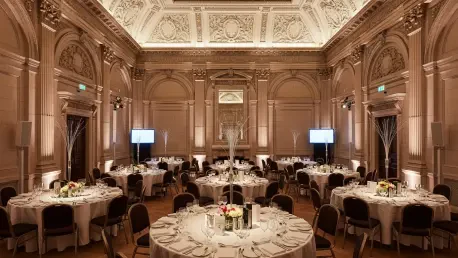
The restoration of the Barts North Wing illustrates a sophisticated trend known as heritage modernization, where historic integrity is preserved while meeting the rigorous technical demands of 2026. Following a comprehensive £9.5 million investment, this Grade I listed 18th-century landmark now features state-of-the-art audio and lighting systems hidden within its classical architecture. This project serves as a blueprint for how older buildings can remain relevant in a market that increasingly values character over sterile, modern boxes. By carefully embedding fiber-optic connectivity and advanced soundproofing into the existing masonry, the venue allows for high-stakes corporate gala dinners to take place in a setting that feels authentic yet operates with the reliability of a new build. This approach appeals to a specific segment of the market that seeks a sense of continuity and prestige without sacrificing the essential digital infrastructure required for live streaming or complex interactive presentations.
This movement toward modernizing historical sites reflects a broader industry consensus that the physical venue itself is a primary driver of event attendance and engagement. When a space offers a unique historical narrative, it provides a built-in “wow factor” that new constructions often struggle to replicate, but this advantage is lost if the venue cannot support modern power and data requirements. Therefore, the successful integration of hidden technology ensures that heritage sites can compete on a level playing field with modern hotels and purpose-built conference centers. The ability to host a seamless, high-definition digital broadcast from an 18th-century hall represents the peak of venue versatility. This dual focus on preservation and innovation ensures that the United Kingdom remains a premier destination for international events, as it can offer experiences that are deeply rooted in local history while remaining at the cutting edge of global technological standards and professional luxury.
Reimagining Social Interaction: Digital Innovation
The emergence of venues like the Poolhouse at London’s Broadgate campus signals a significant shift toward experiential and competitive socializing environments that depart from traditional ballroom settings. This venue utilizes AI-powered pool tables and immersive projection mapping technology to transform a standard leisure activity into a high-tech brand activation tool. By merging digital interfaces with physical gameplay, the space caters to a growing demand for interactive team-building events where the technology facilitates social bonding rather than just acting as a backdrop. Such venues are increasingly popular for corporate mixers and product launches because they provide a relaxed yet stimulating environment that encourages natural networking. The use of augmented reality overlays on the playing surfaces allows for personalized branding and real-time social media integration, making the event inherently shareable and highly engaging for a demographic that values interactive and tactile experiences.
Industry leaders recognized that the successful venues of the future were those that moved away from one-size-fits-all models toward specialized, tech-integrated ecosystems. The transition from 2026 toward 2028 was marked by a strategic focus on three pillars: technical production excellence, historical narrative, and interactive social experiences. Organizers realized that the most effective strategy involved choosing sites that eliminated the friction between aesthetic charm and functional reliability. Moving forward, the priority became the creation of frictionless event journeys where digital and physical elements were indistinguishable. Future considerations for developers now include the implementation of more robust 6G networks and AI-driven concierge services to further personalize the attendee experience. By embracing these diverse innovations, the UK market established a new standard for global hospitality, ensuring that venues were no longer just static locations but dynamic participants in the success of every event they hosted.